“Investor ready”. Founders say it like it’s a finish line. But VCs want proof that you’ve reached that stage.
When you’re building the deck, you’re using it to show how much you believe in what you’re building. However, investors, on the other side of the table, are reading your pitch deck for risk.
In this conversation, SeedLegals CEO Anthony Rose sits down with Tova Feldheim and Caroline Jerome, co-founders of York Effect – a duo who have spent years decoding what actually makes a founder worth funding. Join them as they reveal how VCs really interpret your deck and how you can go from feeling ready to being truly backable.
Watch below.
Key takeaways
Read the room and tailor to the audience
- Before you even open your deck, do your homework. Know not just what the fund invests in, but the size of the fund, how much capital they’ve already deployed, and whether they write lead or follow-on checks.
- Use the first part of your investor meeting to get them talking. Ask what they’re looking for, which companies in your space they’ve backed, and whether they typically lead or follow. This will help you tailor your pitch and make you stand out as ‘the founder that listened’.
- Build relationships before you’re ready to raise. When you’re ready, one of those relationships could refer you to someone that becomes your lead investor.
- If a conversation feels polite but flat, trust the signal. Instead of letting it drift, respectfully acknowledge it: ‘I am getting the sense this might not be the right fit – would you be open to giving me some feedback?’
Get your storytelling techniques up to scratch
- Investors are interested in not only your problem and solution but they also your journey. What did you believe to be true? What did you learn? How did you adjust your course?
- Avoid making big logical leaps. If you’re building a luxury brand but start talking about serving underserved communities, this could cause confusion. Reduce the work for the investors, so they spend less time trying to connect the dots and more time deeply listening.
- Your pitch should be a conversation, not a monologue – so aim for 10 minutes walking through the deck, 10 minutes of discussion.
Designing with intent: clarity over complexity
- Keep the writing short and sweet. If your slides are too text-heavy, investors will have a hard time focusing on what you’re saying because they’re busy reading.
- Prioritise consistency in formatting. Same fonts, same heading styles, same placement throughout the deck. When every slide follows the same visual logic, investors can follow your narrative more easily.
- Ask yourself: where is the user in this slide? If your visuals show abstract concepts – a globe, an iceberg, a network map – but no actual person using your product, you’ve lost the thread. Investors need to see who’s going to pay you.
Perfect your pitch
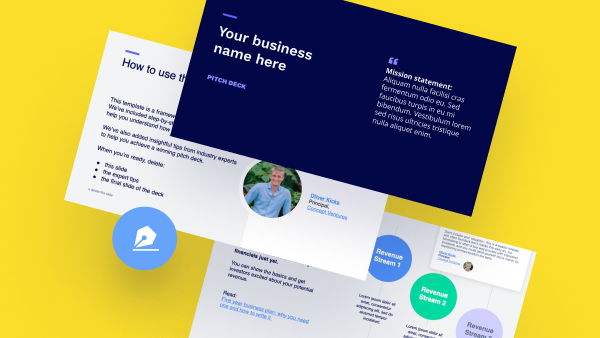
Use our free ultimate pitch deck template: includes step-by-step guidance & tips from investors.
Get the free templateWhat traction really means to investors
- Traction means showing you understand which customers matter. Narrowing your market isn’t a weakness; it’s proof you’ve done the work and you have the information you need to sharpen your product.
- Hyperbole is a credibility-killer. Claiming a billion-dollar TAM when you’re solving a niche problem makes you look more naive than ambitious. Investors know when you’re inflating numbers to impress them.
- Your TAM slide is where the conversation shifts from the story to how the investor makes money. Show them a credible path to £100M+ in revenue, whether that’s dominating a niche or expanding into adjacent markets over time.
- Your market slide will help you express that you’ve thought beyond today. You might start focused on UK early-stage startups, but show the investor you see the US, see adjacent sectors, and have a phased plan to get there.
A good idea or a great one: can the business scale?
- Investors don’t want to see operational complexity increasing. Pricing changes deal by deal, and product gets modified per industry. That’s lumpy revenue, and it doesn’t scale, so tackle one segment first, then expand if you have capacity.
- ‘Fake it till you make it’ but do so responsibly. If your website says ‘call us’ instead of ‘sign up’, you’re signalling you don’t have customers. Look at how successful products in your space present themselves, and design your site to feel like a service that’s already being used by thousands.
- When an investor asks how many customers you have, you don’t need to inflate the number – but you do need to show them you’re thinking like a business that’s about to have hundreds. What would your pricing model look like at scale? How would customer acquisition work? Have those answers ready.
The points that investors are evaluating most
- Remember that investors are assessing how you run your business. The money you’re asking for needs to make sense in the story you’ve just told. A pie chart showing 20% to ops, 40% to dev, and 40% to marketing doesn’t tell them anything. Show them all of your reasoning clearly.
- When you’re talking to associates or scouts, be strategic. They’re not making the final decision, but they can be a valuable source of information. Ask who they’ve recently invested in and use the conversation to learn.
- Make sure your request for capital follows logically from the validation work you’ve shown. This way, investors stop hearing a pitch and start seeing a partner.
Get answers fast, for free
Bring all your questions - we’ve got the answers!
We’ll match you with the right specialist.