













Startups made easy. Sorted.

Enterprise Management Incentive scheme

Build your dream scheme: EMI made easy

Create and manage your EMI scheme on our automated platform with unlimited help from our EMI experts.
  • 60,000+

    companies use SeedLegals

  • 1 in 4

    EMI schemes in the UK are set up on SeedLegals

  • up to 4 x

    lower price than lawyers and accountants

Reward and retain your team

EMI share options are a low cost, tax efficient way to reward your UK staff with equity.

  • Icon support chat bubble

    Get help from experts

    Our EMI experts have an in-depth understanding of all the terms related to your scheme. They’re on hand to guide you and review your scheme every step of the way.
  • Icon coins

    Save money

    Our pricing is low and transparent (a fraction of the cost of lawyers and accountants). Unlimited expert help is included - no hidden costs.
  • Icon add user

    Build your dream team

    Make your company a great place to work by giving share options. Our EMI plan includes a portal to help option holders stay engaged and motivated.
  • Icon Rocket

    Boost efficiency

    Create and run your scheme on one automated platform, save time using our guided workflow and eliminate errors. Your scheme is customisable and fully compliant with HMRC.
  • Employee share option schemes made easy

    The most tax-efficient option scheme for your staff - and for you

    Join over 14,000 UK companies using EMI schemes.

    • tickAttract, retain and motivate staff
    • tickAlign your team with your company goals
    • tickGet Corporation Tax relief for your company
    • tickGrant tax-advantaged options to your staff

    Set up EMI share scheme

    The easy way to create and run your EMI scheme

    Generate all the documents automatically. Our EMI experts check the details for you and they're on hand if you need any help.

    • tickBuild and customise your scheme
    • tickSign and store all the documents on SeedLegals
    • tickAdd new joiners anytime, issue option grants instantly
    • tickView options issued and exercised
    EMI share option schemes

    Employee dashboard for your team

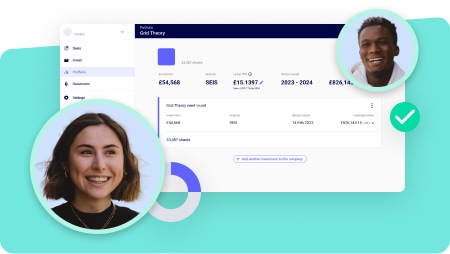
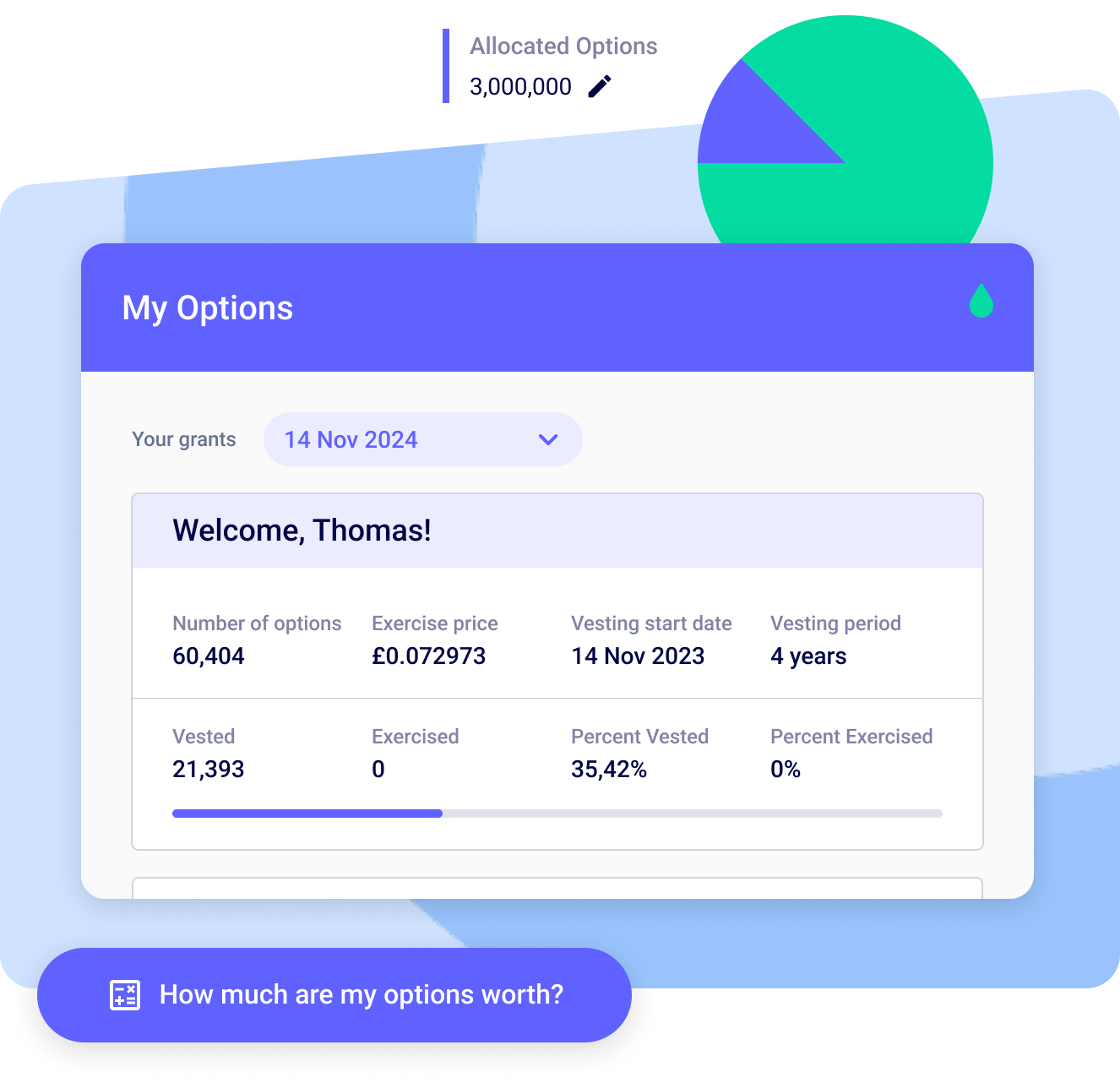
    With our easy-to-use option holder portal, employees can watch the worth of their options grow and track vesting.

    • tickEmployee portal included in your membership
    • tick Keep employees motivated and engaged
    • tickFor options holders: track vesting
    • tickFor options holders: use the calculator to see what options would be worth for any valuation
    Fast and accurate EMI valuation

    Get an accurate valuation and the best deal for your staff

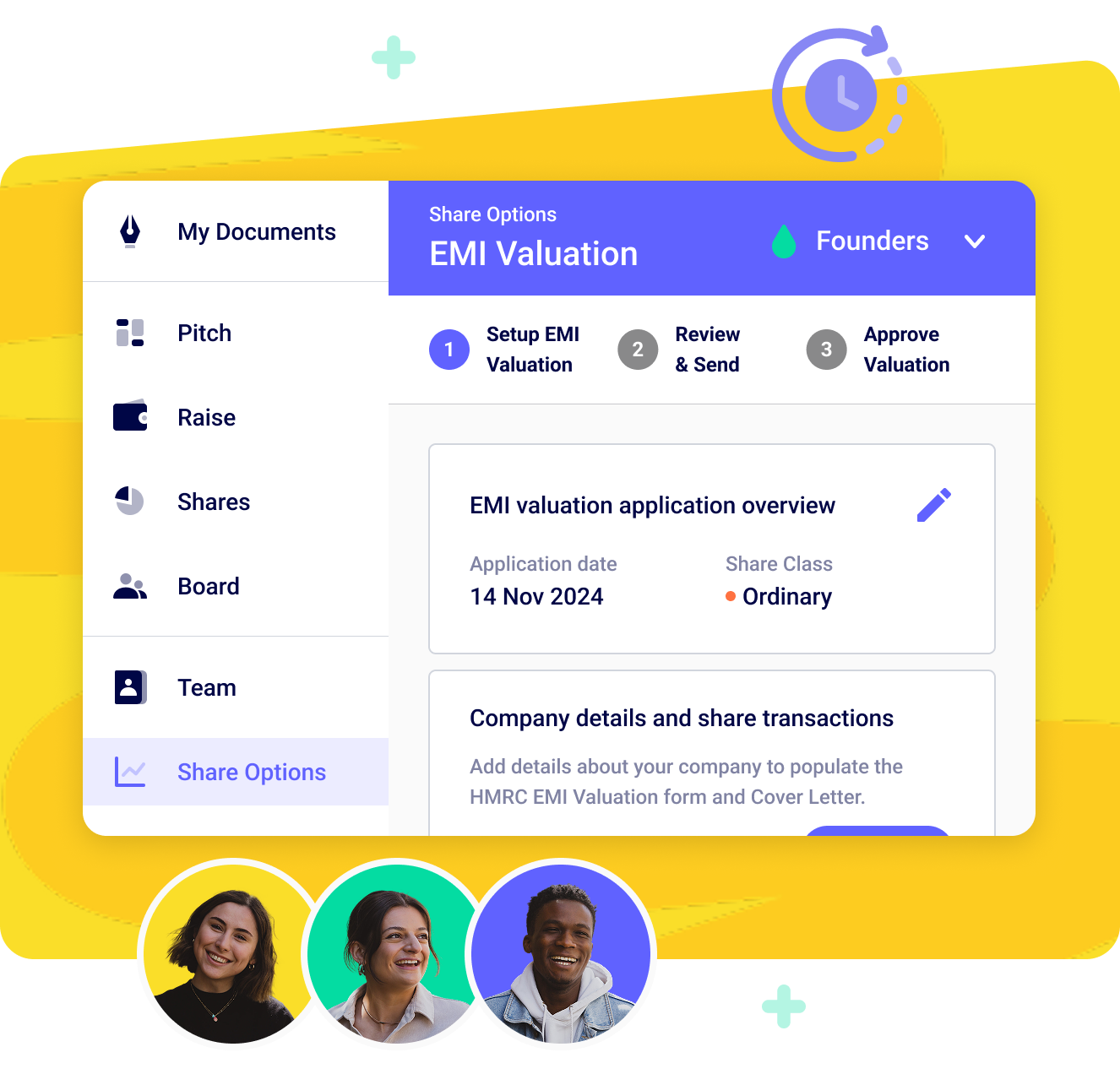
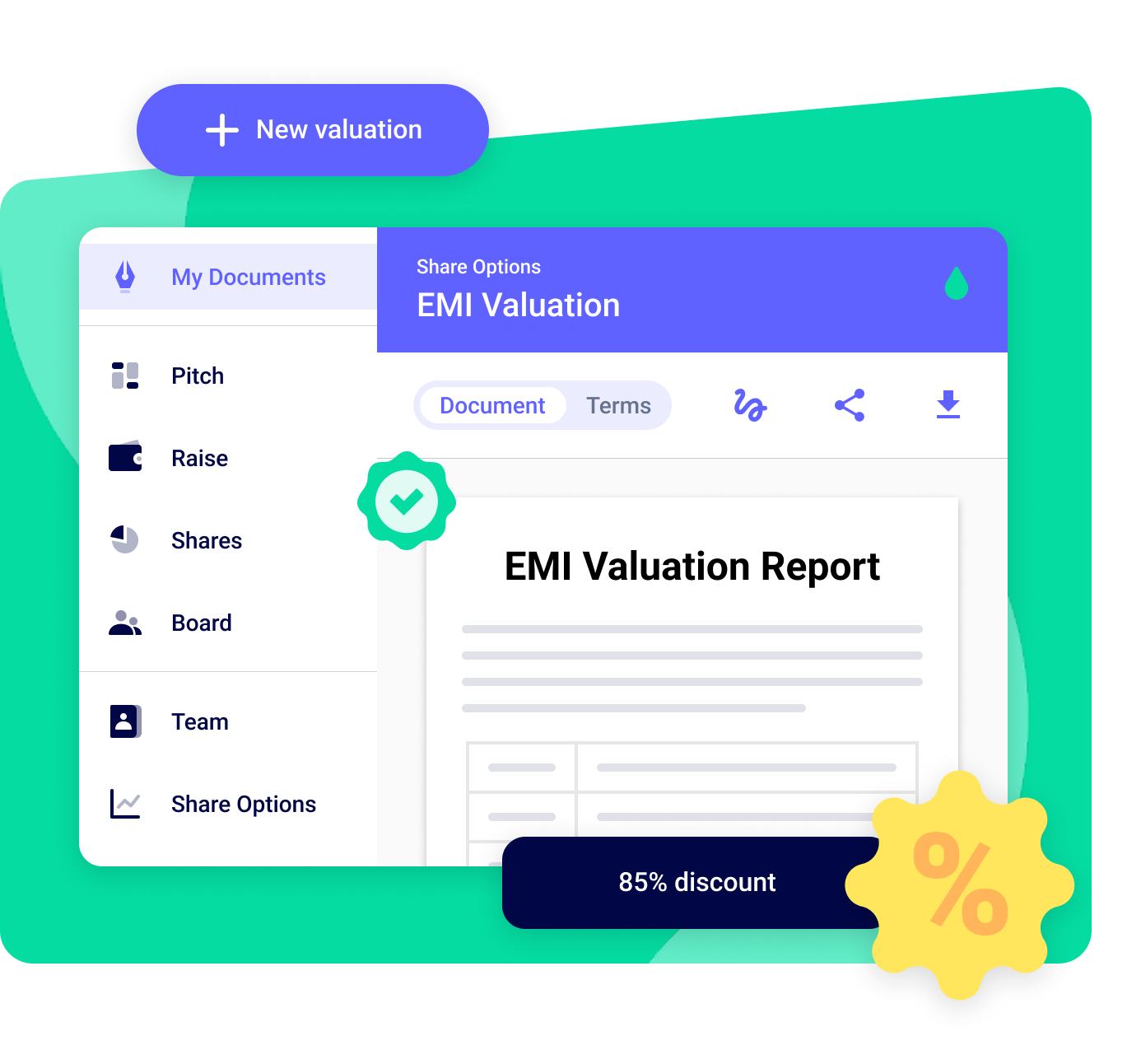
    Our valuation tool builds your EMI valuation report in minutes to help you achieve the best possible discount for your employees - up to 70%.

    • tickGet an accurate EMI valuation for your company and employees
    • tickTrust our proven, HMRC-compliant process
    • tickSpeed up your EMI valuation and get approved fast
    EMI scheme help

    Unlimited expert help is included

    Our team of EMI experts is on hand to guide you where needed, answer your questions and review your documents.

    • tickUnlimited support is included at no extra cost
    • tickTalk to us via chat, phone, email or video call
    • tickAsk us anything - we're here 9am to 6pm Monday to Friday

    • Log in or register

      It takes less than 3 minutes to create your SeedLegals account

    • Create EMI option pool

      Set aside a slice of equity to share with your team

    • Set EMI scheme rules

      Choose how your team's options will vest and when they can be exercised

    • Get an expert review

      We'll review everything in your scheme, so you can be confident it's right for you and your team

    • Pass board resolution

      It's quick to get everything signed and sealed on SeedLegals

    FAQs

    Frequently asked questions about EMI share option schemes


    • What is an EMI share option scheme?

      The EMI share option scheme is an HMRC initiative that allows UK businesses to give share options to their employees with significant tax benefits. It’s designed to support smaller businesses and make granting equity easier as a tool to attract and incentivise staff.

      You can read more about EMI schemes in our article: Share options explained: the essential guide for UK startups
    • How do I set up an EMI scheme?

      On SeedLegals it’s easy - and we’ll help you at every step.

      1. Find out if you qualify for EMI (read our post You can read more about EMI schemes in our article Does your company qualify for an EMI option scheme?

      2. Create your option pool

      3. Create your option scheme in minutes using our guided workflow

      4. Choose vesting and exercise rules

      5. Pass a board resolution to adopt the option scheme

      6. Grant the options

      7. Enter your team members’ details and details of the option grant

      8. Send out the option agreements to your team for signatures

      9. Log in any time to view your scheme at a glance and add new option holders in minutes
    • What do SeedLegals EMI experts help with?

      Our EMI experts have helped thousands of companies create their schemes. The team has an in-depth understanding of HMRC’s guidelines and all the terms in your EMI scheme. We can help you:

      • Decide on types of options to offer

      • Set the exercise price

      • Determine vesting periods

      • Review your documents and scheme

      • Answer any questions

      We set up 1 in 4 EMI schemes in the UK, so we have plenty of experience to draw on.
    • What are the tax benefits of EMI options for my business?

      Each company and individual is unique so we recommend you consult your accountant or tax specialist.

      With an EMI option scheme, your company can claim Corporation Tax relief when the employee sells the shares and when they exercise the shares (if those shares were granted at a discount).

      • If you grant an employee options at the actual market value (AMV), the Income Tax charge when they exercise the options is zero, so there is no Corporation Tax deduction in this scenario.

      • If you grant an employee options at a discount, the Income Tax they pay is on the difference between the actual market value (AMV) and the discount. Your company can claim Corporation Tax relief equal to the Income Tax amount the employee paid.

      • If an employee sells the shares, they will pay Capital Gains Tax. Your company can claim a further Corporation Tax deduction equal to the amount of Capital Gains Tax the employee paid.

      You can read more about this in our article: Tax implications on share option schemes.
    • What are the tax benefits of EMI options for employees?

      Each individual is unique so we recommend you consult your accountant or tax specialist.

      HMRC’s very popular EMI scheme allows tax advantages for both employees and companies that are eligible for the scheme. The tax advantages of EMI options for employees include:

      • No Income Tax or National Insurance Contributions (NIC) is charged when the options are granted

      • If the employee exercises their options at the pre-agreed market value (AMV) with HMRC, they won’t pay Income Tax or NIC on exercise either

      • If the employee has held their options or shares for at least two years before they sell them, the Capital Gains Tax they pay on sale will be reduced from 20% to 10%

      You can read more about this in our article Tax implications on share option schemes.
    • What are the qualifying conditions for an EMI scheme for companies?

      • You must be actively trading and have a permanent establishment in the UK

      • You must have fewer than 250 full-time employees when the EMI options are granted

      • Your company must have £30 million or less in gross assets

      • You must not have already allocated over £3 million worth of EMI shares

      • You must not be owned by a parent (holding) company or under the control of another company

      • If you have a subsidiary company, it must also meet the EMI qualification requirements

      • You must notify HMRC within 92 days of granting the options

      • Your company must not carry out a substantial amount of the ‘excluded activities’. You can find the list of excluded activities at the gov.uk website

      To see the full list of EMI rules, head over to the HMRC manual for EMI schemes.
    • What are the qualifying conditions for an EMI scheme for employees?

      • They are a legal employee on your PAYE payroll

      • They work at least 25 hours a week or 75% of their weekly working time

      • They hold less than 30% of all company shares

      • The total market value of the options they hold doesn’t exceed £250,000
    • How much does it cost to set up an EMI scheme?

      Traditionally, setting up an EMI option scheme was expensive: it could cost up to £5,000 to £10,000. You’d need to hire a law firm to draft the scheme rules and bring an accountant in to draft a valuation for submission to HMRC. This could take months and you’d be on your own when managing the scheme with HMRC.

      SeedLegals has changed all this. Using our platform, you can create your EMI scheme, set vesting conditions, have law-firm-quality legal drafts, a market-leading valuation, and get help with all the ongoing management of the scheme. This comes at a fraction of the cost of lawyers or accountants: with SeedLegals it’s £2,490 per year to set up, grant and manage your options. . To run your scheme, you’ll need a SeedLegals Options Subscription, which includes a range of services and discounts.
    • What is the share options calculator and how does it work?

      The SeedLegals options dashboard makes it easy for your team to understand the value of their options.

      When you share the Option Agreement with a team member, they will get an invitation with a link to create their own SeedLegals account.

      On their dashboard, your option holders can see the vesting status of their allocation, their Option Agreement, Option Certificate and Share Certificate (after they have exercised their options).

      As well as this, they can use the options calculator. The calculator helps answer two common questions: how much are their options worth based on a specified valuation (they can type in any valuation to model different scenarios), and how much it would cost to exercise a given number of their vested options.

      For more information about this helpful tool, see our article about the options dashboard and calculator.
    • What are the most important dates for the EMI Option Scheme

      EMI Option Scheme important dates, don't miss them!
      When granting options under an EMI Option Scheme some things need to be done in a certain order and within a strict time limit.
      EMI Valuations are usually valid for 90 days*
      Valuations for EMIs are usually valid for 90 days* from the date of the agreement. You may be able to extend this agreement period for a further 30 days by writing to the HMRC EMI team ("SAV"). Include written confirmation that no significant events have happened since the original valuation or are likely to happen in the period for which you’re asking for the extension.

      EMI options must be granted within 90 days*
      A company must grant a option within 90 days* of receiving an EMI valuation for that option to qualify for the agreed valuation.

      Any options granted after that will not be covered by that valuation, and the company and employee could end up with hefty tax liabilities when the option is exercised later - so after that 90 days has elapsed you'll need to request another valuation before issuing the next batch of options.

      Employees have 7 or 14 days to countersign their Option Agreement
      The employee must return the signed Option Agreement within 7 or 14 days to the Company. Please check your individual grants to ensure the correct countersign window is followed.

      You must inform HMRC by 6 July of an options grant
      Grants made after 6 April 2024: You must tell HMRC about a grant of an EMI option by 6 July following the tax year the grant was made in, as stated under schedule 5 Income Tax (Earnings and Pensions) Act 2003.

      If you don’t tell HMRC about the grant by 6 July, you risk losing any tax benefits for you and your employee.

      -----------------------------------------------------------------------------------------------------------------------

      Grants made before 6 April 2024: You must tell HMRC about a grant of an EMI option within 92 days of the date of the grant under schedule 5 Income Tax (Earnings and Pensions) Act 2003.

      If you don’t tell HMRC about the grant within 92 days, you risk losing any tax benefits for you and your employee.

      You must do an annual return before 6 July
      The Company must complete an online end-of-year return on or before 6 July for each registered EMI scheme.
    • What is an EMI Valuation and why do I need one?

      In order to get the full tax benefits of EMI, you need to agree the price of the share option you are offering to employees with HMRC. This is because when the employee decides to exercise their share options to convert them into actual shares, they have to pay the strike price per share agreed with HMRC so they do not get taxed upon the exercise event.

      When agreeing the strike price with HMRC, you aim to argue for a low company valuation - i.e. the contrary to what you would be doing when negotiating your company’s valuation with investors. The lower the strike price, the greater the benefit for the employee.

      If you are offering share options that are of a share class which is the same or similar to a share class that investors paid for during a previous funding round of your company, then the strike price agreed with HMRC will be close to the price per share paid by the investors for this share class.

      If you are offering share options under a completely different share class (e.g. B Ordinary (Non Voting) shares), you can argue a lower strike price with HMRC, even if you had a funding round in the past for a different share class.

      Once HMRC accepts the proposed strike price, then you are free to grant share options to employees at the agreed strike price within a period of 90 days from the date of HMRC's acceptance letter.
    • How to setup your EMI options scheme on SeedLegals

      EMI Share Option Scheme - step by step guide to setting up your scheme

      The Enterprise Management Incentive (EMI) Scheme is UK’s tax efficient way of granting share options to employees. Through EMI, there is no tax payable when you grant an employee a share option, no tax payable when the employee exercises the share option at the strike price agreed with HMRC, and when the underlying share is later on sold at a profit the capital gains tax is set at 14% (instead of the standard rate of capital gains tax). SeedLegals’ EMI Option Scheme is fully compliant with UK’s legislation. Here’s an article to help you decide when the right time is to set up an EMI Option Scheme.

      Please ensure your company qualifies for an EMI Share Option Scheme, here is an interesting article you might want to check out.

      This guide will walk you through the full process of setting up your EMI options scheme on SeedLegals.

      1. Create an Option Pool
      2. Input your EMI Valuation details
      3. Set up your EMI Option Scheme
      4. Register your EMI Options Scheme with HMRC
      5. Grant options
      6. Notify HMRC of your Option Grants
      7. Joint NIC Election

      1. Create an Option pool
      This should already be completed by this stage, but if not, please follow along with this guide: How to create an option pool

      2. Input your EMI Valuation details
      You should have a valid EMI Valuation from HMRC, our step-by-step guide to completing your EMI Valuation application on SeedLegals can be found here.

      Input the approved AMV and UMV from your EMI Valuation approval letter to your EMI Valuation.

      3. Set up your EMI Option Scheme
      We have a video tutorial taking you through the next steps following receipt of an approved EMI Valuation from HMRC here.

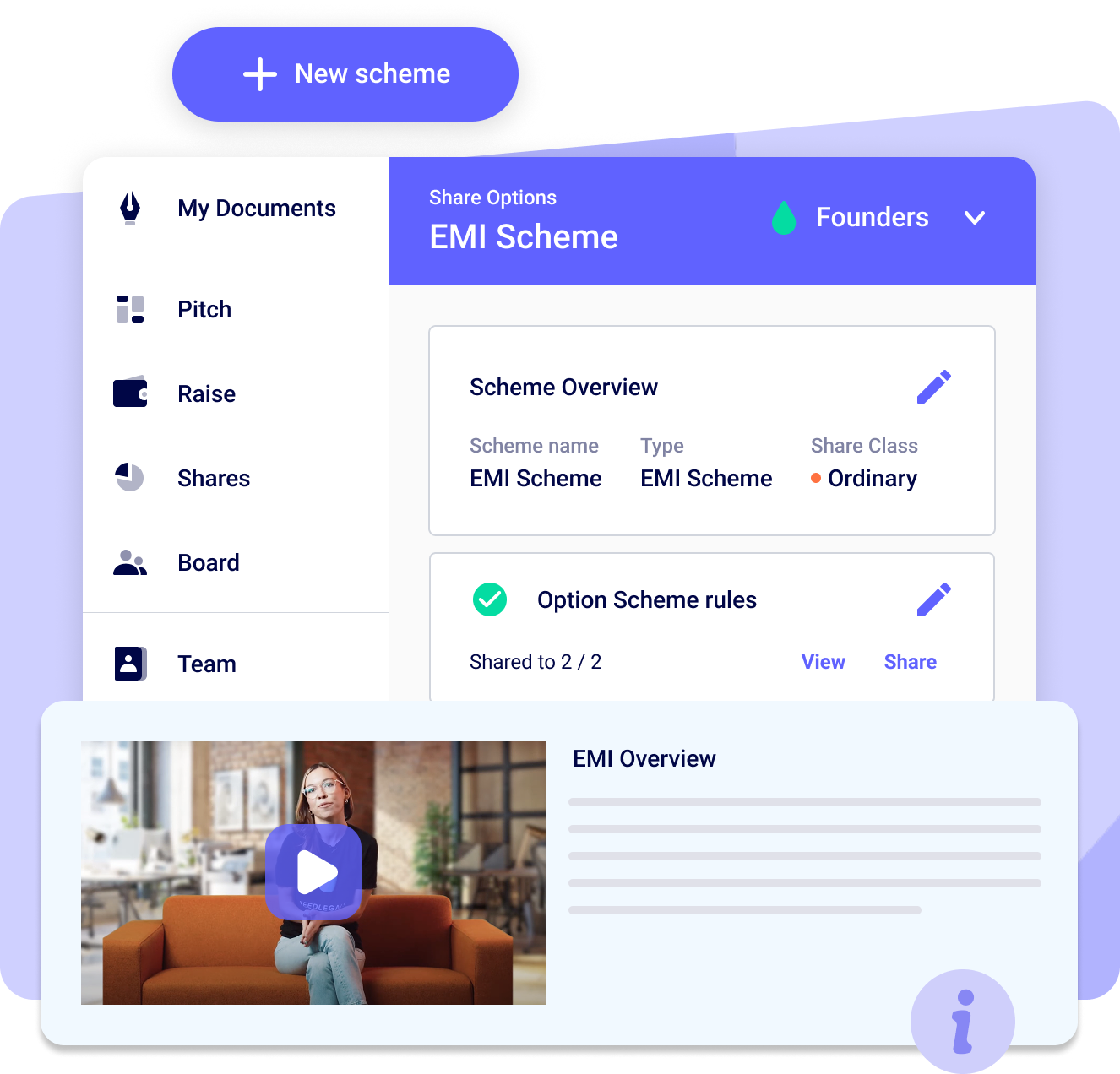
      You can set up your EMI scheme from the Share Options window on the left-hand side of your SeedLegals Dashboard and then click 'view scheme' on your EMI Scheme.

      Then, under the pencil button next to the Option Scheme rules, you can choose the terms of your scheme relating to vesting and exercise. These rules will be the default rules for each team member added to the scheme, however, if you wish to, you can change the vesting rules when granting to specific team members.


      You may want to check out our guide with the most commonly selected terms here.

      Once you have completed the EMI scheme rules, then you are ready for the company to adopt the Option Scheme.

      Please hold a board meeting and then enter the details of the meeting under the Board Resolution below. Then the chairperson will sign the Board Resolution.

      4. Register your EMI Options Scheme with HMRC
      Please remember to register your EMI Scheme with HMRC, our guide here will take you through just how to do so.

      Once done, please input the date of your registration into the EMI Scheme workflow and hit 'Adopt scheme'.

      If you have previously registered your EMI Scheme, you may skip this step.

      5. Grant options
      You can now set up your option grants for your employees using our guide here. You may find our short Loom video guide here useful as well.

      Please remember to hit 'Approve option grant' when you are done! You will then be able to issue option certificates to your option holders.

      To do so, head back to the Share Options window and click on the Option Certificates tab.

      You'll then see the option certificates for your option holders. Hit Sign All for all of your Option Certificates, and Actions: Email Certificates to send them out to your options holders.

      This short video takes you through Option Certificates on SeedLegals.

      6. Notify HMRC of your option grants
      Any grants made on or after 6 April 2024 only need to be notified to HMRC once a year along with your EMI Annual Return by the 6th of July every year. Our guide here will take you through just how to do so.

      However, we strongly urge companies to report regularly, such as once the options are granted. Instead of waiting until the deadline to make the notification, to avoid the risk of missing the filing.

      7. Joint NIC Election
      This needs to be done before the exercise of any options, but you may wish to do so earlier so that you don't have to worry about it in the future.

      Our guide here takes you through how to submit a blank election, together with a fully signed option agreement to HMRC for approval. This only needs to be done once, meaning once it has been approved for a single option holder, you will be able to sign other NIC Elections for the rest of your option holders without seeking separate approvals.

      Our short video here takes you through how to navigate the NIC Election on SeedLegals.

      8. The team will complete a final review of your scheme
      Please reach out to your dedicated Options Scheme owner so they can help review your option grants to ensure everything is in order.

      If you have successfully followed all of these steps then congratulations, you will have successfully completed your EMI options scheme. Which you can view at any time from the Share Options window on your dashboard.
    • Why do I want a low EMI Valuation?

      As part of setting up an EMI Option Scheme, you agree what the value of your company is with HMRC.

      Sometimes founders get confused by this, because they've just been trying to argue up valuations with investors.

      However - EMI valuations are completely separate - here's an example about why it's beneficial to argue your valuation down.

      NewCo Ltd - without a discount

      NewCo recently closed a funding round at a £2m pre-money valuation at £1 an Ordinary share

      Later, NewCo wishes to grant employees some share options. NewCo could use the price of the last funding round as the strike price - (the price that the employee pays to buy the share) to £1 too.

      2 years later, NewCo exits for £6.5m - or £3/share. The holder of the option makes a £2 profit.

      This profit is taxed at the 14% entrepreneurs' relief rate. However, this is will increase to 18% on April 6th, 2026.

      NewCo - with a lower EMI valuation

      Instead of accepting the previous funding round valuation, NewCo submitted a valuation report to HMRC, trying to argue down the valuation for its EMI Options.

      This is normally done by granting options under a new share class, with fewer rights. For example, the share class for the options might not have voting rights.

      HMRC agrees that the price of this share class is £0.50/share.

      Now when NewCo exits at £3/share, the holder of the option makes a £2.50 profit - taxed at the 10% entrepreneurs relief rate.

      SeedLegals has helped dozens of companies lower the price of their EMI options with our valuation report - hit the chat button to get started.

      Reach out to chat with a member of the team about your EMI Valuation!
    • What are the most common mistakes on the EMI valuation

      After reviewing hundreds of valuation applications, the team has some tips on how to avoid the three most common mistakes.

      1) Providing insufficient detail and not being specific enough
      As each EMI Valuation is unique to a company, it is important that you provide sufficient detail that is specific to your company, so that it is less likely that HMRC will have to ask for more information.

      For example, for each discount that is applicable to you, we recommend you add supporting details or evidence where applicable.

      Take our Market Impact discount for example, it is important that your explanation is specific to your company and is as detailed as possible. As far as possible, any claims should be evidenced with data and explanations as to how it has affected your company specifically, as opposed to the market in general.

      2) Not having the right accounts or balance sheet
      It’s really important to have the right set of accounts and a recent balance sheet or else HMRC might have some questions on your application.

      For the accounts:
      If you’ve been trading for 3 years or more, please provide the last three years’ worth of accounts
      If you’ve been trading for less than 3 years, then provide what you have
      If you are pre-revenue, no need for accounts
      If your last filed accounts are older than 9 months, then also include your most recent management accounts

      For the balance sheet:
      The more recent, the better - we suggest within 1-2 months from today
      If you’ve had a recent investment round, then the balance sheet must be from after that round

      3) Incorrect answers to these questions:
      For the first question, please include share allotments that have occurred since your last company accounts were filed at Companies House.
      These share allotments include investment rounds and other share issuances. Exclude share transfers.
      The format should be: dd/mm/yyyy - x shares allotted for a price per share of £x.xx
      The second question refers to any share transfers or share buybacks that have happened in the past year since the date of the application.

    You’re in safe hands

    Our team of legal and funding experts have helped thousands of entrepreneurs raise money and grow their businesses.

    • Beautifully organised

      Your company's core agreements, all in one place

    • Secure signatures

      Share and collect signatures online via SeedLegals

    • Backed by real lawyers

      Create the exact documents you need at every stage of growth

    • Serious about security

      Your information stays safe and confidential in our secure system

    • Helpful humans

      Talk to one of our friendly team anytime on live chat

    • Extra protection

      Don't worry, our insurance covers claims related to our platform

    We’ve helped over 60,000
    companies

    From food to FinTech and beyond, join thousands of startups who use SeedLegals to start, raise and grow faster.

    • Yoller
    • Logo
    • Pluto 2
    • The Family 2
    • Trim It
    • Oddbox Logo
    More customer stories
    • Louise Doherty
      Quotes

      The reality is you’re on a journey; fundraising is so much about the narrative. SeedLegals allows you to tell the right story at the right time with the right legal documents for different types of investors.


      Louise Doherty

      Founder & CEO, Yoller

      Yoller
    • Qure
      Quotes

      SeedLegals held our hand through complex investor negotiations and even picked up on some errors produced by our previous lawyers which were a well-known City law firm!


      Alex Templeton

      Founder & CEO, Qured

      Logo
    • Pluto
      Quotes

      One of the great things about SeedLegals is that it is designed to be appropriate for the round and the stage of the business. They keep it simple. It feels like they really understand that.


      Alex Rainey

      Co-founder & CEO, Pluto

      Pluto 2
    • Thefamily
      Quotes

      How do I get all the businesses I invest in to use SeedLegals?


      Alexander Wyndham

      Angel Investor , The Family

      The Family 2
    • Darren Trimit
      Quotes

      It's easy to forget about the legal side of things but SeedLegals make things really easy to understand. The team at SeedLegals are truly amazing.


      Darren Tenkorang

      Founder, TRIM-IT

      Trim It
    • Quotes

      There’s an opportunity to reach a specialist advisor via chat, phone and email to check in on anything. The SeedLegals team were extremely responsive – really amazing.


      Emilie Vanpoperinghe

      Co-Founder, OddBox

      Oddbox Logo
    • Yoller
    • Logo
    • Pluto 2
    • The Family 2
    • Trim It
    • Oddbox Logo

    Start your journey with us

    • Beulah
    • Brolly
    • Oddbox Transparent
    • Index Ventures
    • Seedcamp
    • Qured