









How to spot the right moment to flip from LLC to C corp
Not sure whether to flip from LLC to C corp? Learn the key triggers,the risks of moving too early or late, and how to ge...


Already have an account? Log in


Surprisingly few founders know about it, but Qualified Small Business Stock (QSBS) is one of the biggest tax breaks available to startup founders, investors and early employees.
If your company qualifies, shareholders could pay little or no federal capital gains tax when they sell their stock. For stock issued after July 4, 2025, shareholders may qualify for:
The rules are set out in Section 1202 of the Internal Revenue Code. If your company qualifies, QSBS can make your startup more attractive to investors and potential employees. And if you’re a founder, you could benefit from the tax relief too.
In this guide, we’ll explain how QSBS works, how your company can qualify, and what you need to do to maximise the tax benefits.
Your investors could pay less federal capital gains tax when they sell their stock
For federal tax, your investors can exclude 100% of the gain up to $15 million, or 10 times their original investment value of the stock, whichever is greater.
For stock issued after July 4, 2025, investors may also qualify for a 50% exclusion after holding their stock for three years, or a 75% exclusion after four years, before becoming eligible for the full 100% exclusion after five years.
For example, if they make an investment of $500,000 which qualifies as QSBS, and later sell the stock for $5.5 million, they can exclude the entire gain of $5 million when calculating their federal capital gains tax (effectively saving $1,190,000 based on current federal capital gains tax rates of 20% plus the 3.8% Medicare surtax for high earners). By telling potential investors about this tax benefit, you’ll make your company more attractive to them. We’ve written this article on QSBS for investors which you can share with them. It covers the benefits of QSBS for investors and what they should do to qualify.
| Without QSBS benefit | With QSBS benefit | |
| Investment amount | $500,000 | $500,000 |
| Sale price | $5.5 million | $5.5 million |
| Capital gains taxable amount | $5 million | $0 |
| Capital gains tax paid (based on federal capital gains tax rates of 20% plus 3.8% Medicare surtax for high earners) | $1.19 million | $0 |
Your investors could pay less state capital gains tax when they sell their stock
Many U.S. states conform to the federal QSBS rules, offering the same tax benefits at state level. For example, Delaware, New York, Colorado and Connecticut conform to QSBS. Some states only partially conform to the federal rules, and others don’t conform at all (for example, California). Because state tax treatment varies, investors should check the rules in the state where they pay tax.
You could pay less federal and state capital gains tax when you sell your stock
When you eventually sell your stock (for example, in a sale of your company), you can exclude 100% of the federal capital gain up to $15 million.
For stock issued after July 4, 2025, you may also qualify for partial federal tax exclusions after holding your stock for three or four years, before becoming eligible for the full exclusion after five years.
If you’re in a state that conforms to QSBS (like Delaware, New York, Colorado, or Connecticut), you could get similar state capital gains tax benefits.
Your employees could pay less federal (and state) capital gains tax when they sell their stock
If you are planning to incentivize your employees with stock or stock options, they could also benefit from QSBS tax relief.
For qualifying stock issued after July 4, 2025, employees may also benefit from the new phased tax exclusions after three and four years, provided the other QSBS requirements are met.
If you point out this benefit to any potential employees, it makes joining your company more appealing. Read the FAQ below titled “Do employee stock options qualify as QSBS?”
You could pay less inheritance tax
In some circumstances, you can transfer the QSBS tax benefit into trusts or to heirs, meaning your family can inherit the stock with no immediate tax consequences.
There are a few requirements you need to satisfy to issue QSBS. These should be achievable for most startups, though.
For stock issued before July 5, 2025, shareholders generally need to hold the stock for five years to qualify for the full QSBS exclusion.
If you’ve been raising using SAFEs or convertible debt, see the FAQs below where we explain how this can affect when the holding period begins.
If your company meets these requirements, both founders and investors may be able to benefit from one of the most generous tax incentives available to early-stage startups. It’s worth checking that your company qualifies before issuing stock, as fixing problems later can be difficult.
Here are some questions you (or your investors) might be asking.
How can I assure my investors that my company qualifies to issue QSBS?
It’s important to check you qualify before issuing QSBS to your investors, your employees or yourself. Your investors might expect representations and warranties in the investment documents that state the stock they’ll be receiving meets QSBS requirements.
What do my investors need to do to benefit from QSBS?
We’ve written this article on QSBS for investors which you can share with any current or potential investors. It covers the benefits of QSBS and what they should do to qualify.
I didn’t initially set up my company as a C-corporation. Can I still benefit from QSBS?
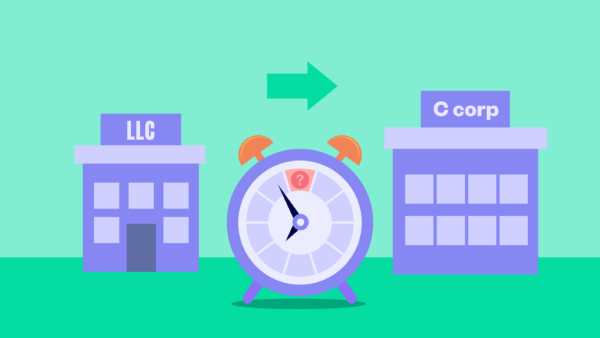
Only C-corporations can issue QSBS, but a company can convert from another structure (such as an LLC or an S-corporation) to a C-corporation and issue QSBS (as long as the other criteria are met). There’s more on how it works in this article.
Also, if you were issued stock before conversion to a C-corporation, you could still benefit from QSBS on that. The gains on that stock before the conversion won’t qualify for QSBS. But gains on the stock after the conversion can qualify for QSBS (provided the company meets the other requirements).
For example, say you own 100 units in an LLC, which grow in value to $5 million. Then, the LLC converts to a C-corporation. After the conversion, the company grows further and your stock is sold for $30 million. In this case, QSBS could apply to the $25 million gain that accrued after the conversion, but not to the initial $5 million from when the company was an LLC.
Can QSBS be held by a company or does it have to be held by an individual?
QSBS is designed to be held by individuals. It can be owned by entities like trusts, partnerships, and S-corporations, but there are limitations and additional requirements. For example, for trusts, the tax benefit can only apply to the beneficiaries if they were beneficiaries at the time the stock was issued. You can find more about QSBS being held by entities at Internal Revenue Code Section 1202(g).
Does QSBS benefit apply to stock that’s transferred by another stockholder (for example, secondaries)?
No, you do not get any QSBS benefit if you are transferred stock from someone else. The QSBS benefit is only available for stock acquired directly from the company.
If I’m issuing stock as part of a fundraise, does the $75 million limit for QSBS include the money I’m raising?
Yes, the $75 million gross assets limit for QSBS does include the funding you’re receiving. So, if the company’s assets, including the new funds, are more than $75 million, the stock will not qualify as QSBS. But if you issue stock that qualifies as QSBS, and further down the line the company’s gross assets exceed $75 million, this doesn’t affect the QSBS status of the stock issued before. In case a fundraise will take you beyond the $75 million limit, you can deal with this by issuing stock in tranches. The company can issue a first tranche of enough QSBS to keep you below the $75 million limit. Then, a day or more after, it can issue a second tranche of non-QSBS which can take you above the $75 million limit. This ensures you can issue as much QSBS as possible without risking its eligibility.
Our company’s assets exceeded $75 million but have now fallen below it. Can we still issue QSBS?
No. Once the company’s aggregate gross assets exceed the applicable threshold, stock issued after that point generally won’t qualify as QSBS, even if the company’s assets later fall below the threshold again.
Does a SAFE qualify as QSBS?
SAFEs can potentially qualify as QSBS, but there is some uncertainty around this. QSBS can only apply to “stock,” and it’s not certain whether the Internal Revenue Service (IRS) classifies a SAFE as “stock”. This distinction is important because of the requirement to hold QSBS for five years to achieve the full benefit. If a SAFE is considered “stock,” the five-year clock starts from the moment the investor enters into the SAFE. If not, the clock only starts from when the SAFE converts to equity in the company at the point it’s issued to the investor. So, it depends on how the IRS classifies it. The Y Combinator SAFE, for instance, is intended to be treated as “stock,” but this characterization isn’t binding on the IRS. If you want to ensure your SAFE investors get QSBS relief sooner, you should consider converting the SAFEs into stock as soon as possible. This way, you reduce the uncertainty around whether the SAFE itself is treated as “stock”. In any case, it’s always worth consulting with your tax advisor for their view on the knock-on effects of treating SAFEs as “stock” for tax purposes.
Does convertible debt qualify as QSBS?
Convertible debt doesn’t qualify as QSBS until it’s converted into stock. The five-year holding period for QSBS starts only when the convertible debt is actually converted into stock. As with SAFEs, you could convert the debt into stock to trigger the five-year holding period required for QSBS.
Do employee stock options qualify as QSBS?
No, employee stock options (including incentive stock options, restricted stock units, or other bonus arrangements) do not qualify as QSBS as the IRS does not consider them as “stock”. If any employees with stock options want to rely on QSBS tax relief, let them know that their five-year holding period only begins from when the stock is issued to them following their exercise of their options.
Book a free call with our team to find out how we can help with your fundraise.
Want to try SeedLegals for free first? Start your 7-day free trial.
Bring all your questions - we’ve got the answers! We’ll match you with the right specialist.

Not sure whether to flip from LLC to C corp? Learn the key triggers,the risks of moving too early or late, and how to ge...

Eni Maj, co-founder of Travel Spoken, shares how the platform is turning travel content into bookable trips using AI – a...

Learn how to incorporate your startup in the USA with our step-by-step expert guide. Avoid common mistakes and get ready...