











Equity Dilution Calculator: Model Startup Dilution Before Your Next Raise
Model your SAFE stack and see your exact founder dilution before your next round. Free equity dilution calculator. Stack...


Already have an account? Log in


Could you sell your startup for hundreds of millions and pay little to no federal tax? It sounds too good to be true, but under the right circumstances, it’s possible.
Some founders have used a legal tax strategy that takes advantage of Qualified Small Business Stock (QSBS) to significantly (or even entirely) cut capital gains taxes on hundreds of millions of dollars.
In this article, we’ll break down the strategy step by step and explain who it may be right for.
Qualified Small Business Stock (QSBS) is a tax break under Section 1202 of the Internal Revenue code that allows founders and investors to exclude up to 100% of federal capital gains tax when selling a qualifying C-corporation.
The tax exemption applies up to the higher of:
This means if your original investment was $10 million, you could exclude up to $100 million of federal capital gains tax.
But there are strict conditions to qualify for QSBS. For example:
To benefit from QSBS, you have to be a C-corp. But starting as an LLC can potentially boost your tax savings.
Let’s break it down.
Most startups incorporate as a C-corp right away. This is typical if you’re planning on raising venture capital.
But some founders start as an LLC first for tax flexibility.
Why? Because LLCs pass losses through to the owners’ tax returns, which can be useful in the early years when a business is unprofitable.
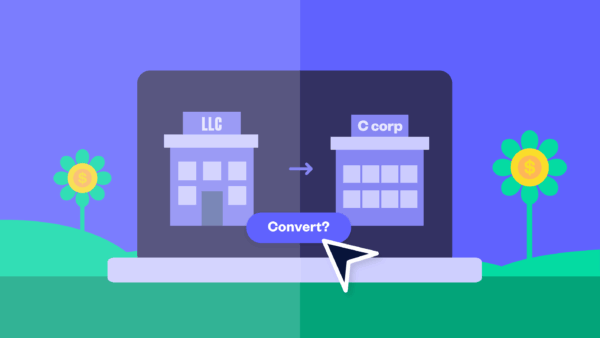
Later, if the company is growing and still under the $75 million asset threshold, it can convert to a C-corp and issue QSBS-eligible stock.
Starting as an LLC means:
If you time this correctly, this can supercharge your QSBS tax exemption as you build value as an LLC, which acts as your base for the 10x basis rule.
So, theoretically if you convert just as your valuation hits $75 million (but before it exceeds it), under the 10x basis rule, you can get up to $500 million in federal tax relief.
Just know that the gains on that stock before the conversion won’t qualify for QSBS.
For example, say you own 100 units in an LLC, which grow in value to $5 million. Then, the LLC converts to a C-corporation. After the conversion, the company grows further and your stock is sold for $20 million. In this case, QSBS could apply to the $15 million gain that accrued after the conversion, but not to the initial $5 million from when the company was an LLC.
Here’s an interesting example we saw shared on X (via @ankurnagpal). It’s a useful illustration of how this works:
The result? No federal capital gains tax on $400 million, potentially saving the founder over $80 million in taxes.
While this tax incentive is big, it’s not right for every startup.
Here’s why:
So, who is this strategy useful for?
Well, it’s probably best for bootstrapped or angel-funded startups that can delay converting to a C-corp until they’ve grown a lot, and that can scale up close to the $50 million valuation threshold without raising a lot of venture investment.
If you’re thinking about this strategy, make sure you get professional tax and legal advice first. A small mistake could cost you millions in lost tax benefits.
Choosing the right company structure can impact your fundraising, investment opportunities and future exit. Whether you’re looking to attract investors, issue shares or plan for long-term growth, we’ve got you covered.
Book a call below or start your 7-day free trial today.
Bring all your questions, we’ve got the answers! We’ll match you with the right specialist.

Model your SAFE stack and see your exact founder dilution before your next round. Free equity dilution calculator. Stack...

Incorporating your startup? Learn the 5 biggest incorporation mistakes founders make and how to avoid costly tax, legal ...

Should you convert your LLC or form a new C corp? This guide explains when conversion is a must and how to get investor-...