Most founders start with an LLC. It’s quick, cheap, and gives you flexibility while you figure out whether your business will work.
But at some point, usually when fundraising starts to feel real, you’ll need to switch to a Delaware C corp.
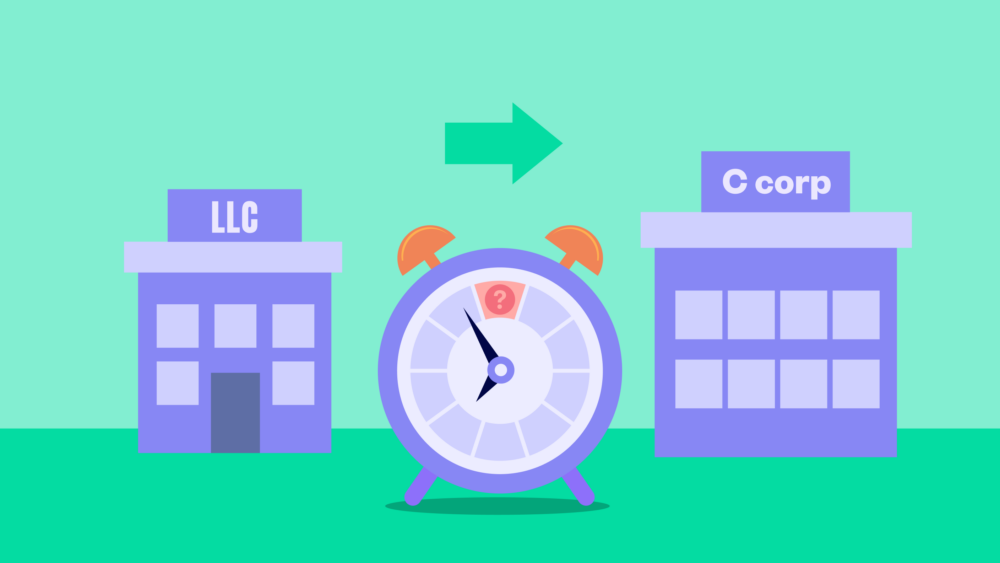
If you’re building a company you plan to scale, the question isn’t really whether you’ll need to make the switch – it’s when.
If you move too early, you’ll be paying costs you don’t need yet. If you wait too long, you might delay a funding round, or miss out on tax benefits.
This guide will help you spot the signals that it’s time to flip – and avoid costly mistakes founders make by getting the timing wrong.
Five signals it’s time to flip
1. You’re starting to have real fundraising conversations
This is the most common trigger. The moment investors move from “interesting idea” to “let’s talk terms,” you need to be thinking about your corporate structure.
Most VCs, angel investors, and accelerators will only invest in a Delaware C corp – and some funds are actually prohibited from investing in anything else. If you’re still an LLC when a term sheet arrives, you’ll need to pause the deal to convert – and that could delay your fundraising process at a critical time.
The smart move is to convert before you start pitching – not after an investor asks you to.
Applying to an accelerator like Y Combinator?
Most work with C corps by default. Converting beforehand means one less thing to sort out during a program that already moves fast.
2. You’re ready to hire and offer equity
If you’re planning to bring on employees or key hires with stock options, you’ll need to be a C corp first.
LLCs can technically incentivize employees (through profit interest units) – but the process is complicated, requires more tax paperwork, and doesn’t carry the same appeal as stock options. C corps let you issue incentive stock options (ISOs), which come with much more favorable tax treatment and are what most employees expect from a startup.
If you’re planning on hiring in the next 6–12 months, that’s a strong signal to start the LLC to C corp conversion now. That way, your equity structure is ready before your first offer letter goes out.
We've written a guide on how to set up your share structure . It covers how many shares to authorize, how much to issue to founders, and how much room to leave for early hires.
3. The QSBS clock is ticking
This is one of the most overlooked timing triggers – and potentially the most valuable.
QSBS lets founders exclude a significant amount of capital gains from federal tax when they sell their shares – in many cases, $15 million or more. If you’ve not heard of it, here’s our QSBS guide for founders.
But there’s a catch. To get the full benefit, you need to hold the stock for at least five years, and the clock only starts when you’re a C corp.
That means every month you stay as an LLC is a month added to your timeline before you qualify for QSBS. If you’re building a company you plan to grow for five or more years, converting sooner rather than later could be worth millions at exit.
Let’s run through an example.
Jordan launched a SaaS startup as a Texas LLC in 2024 and has been growing steadily. In early 2026, they converted it to a Delaware C corp, starting the QSBS clock. By 2031, they’d held the stock for five years.
When they sell the company in 2032, they exclude millions of dollars in gains from federal tax.
Now imagine Jordan had waited until 2028 to convert. The five-year window wouldn’t complete until 2033 – and if the company sold in 2032, Jordan would miss the full QSBS benefit. That two-year delay could cost millions in tax.
Don't forget: if you receive stock subject to vesting as part of the conversion, you'll need to file an 83(b) election within 30 days. Miss that deadline and you could end up paying tax on your stock as it vests (potentially at a much higher value).
The more your LLC does – the more IP it creates, contracts it signs, customers it bills – the harder it becomes to convert.
When your LLC is young and light, converting is straightforward. Everything transfers easily. But the longer you wait, the more you’ll need to deal with:
Reassigning IP (code, patents, trademarks) to the new entity
Getting consent from counterparties on existing contracts
More complex filings across multiple states
If your LLC has created any meaningful IP, signed customers, or brought on co-founders, that’s a signal to convert sooner rather than later. Once you’ve decided it’s time, you’ll need to choose between converting your existing LLC or starting a fresh C corp. We’ve written a guide to help you decide which route is right.
5. You’re thinking about international expansion
If you’re planning to operate outside the US – hiring overseas, selling internationally, or working with foreign investors – a C corp is much better suited than an LLC.
Most countries outside the US recognize corporations but not LLCs. And the way LLCs are taxed can create unexpected complications for foreign members.
A C corp gives you a cleaner, more globally understood structure for cross-border operations.
What happens if you convert too early?
Converting to a C corp isn’t free – and it’s not just about the filing fees. Being a C corp comes with ongoing costs and obligations that not every startup needs yet.
If you convert before you need to, you might end up dealing with:
Double taxation: C corps are taxed at the corporate level, and then again when profits are distributed to shareholders as dividends. If you’re pre-revenue or bootstrapping, you’ll be taking on this structure before there’s a reason to.
Governance overhead: C corps require a board of directors, formal bylaws, annual meetings, and more paperwork. For a solo founder pre-revenue, that’s a lot of admin without much payoff.
Higher costs: Legal fees, accounting complexity, and state franchise taxes (Delaware charges an annual fee) all add up – and they start from day one.
None of this is a reason to avoid converting forever. But if you’re still validating your idea, working solo, and nowhere near fundraising, the LLC structure is doing exactly what it’s designed to do. There’s no rush.
What happens if you wait too long?
Converting late is usually worse than converting early, because the consequences are harder to undo.
You lose fundraising momentum
Imagine you’ve been in conversations with an investor for weeks. They’re ready to move. Then they find out you’re still an LLC. Now, instead of closing the deal, you need to pause everything while you convert.
That introduces delays, which could lead to uncertainty – and investors don’t like uncertainty.
You miss the QSBS window
The five-year QSBS clock only starts when you issue stock as a C corp. There’s no way to backdate it.
If your company exits before the clock runs out, you’ll lose the full benefit of the exclusion – potentially leaving millions on the table.
The conversion itself gets messy
A late conversion means more IP to reassign, more contracts to novate, more tax implications to work through, and potentially more members who need to consent.
What could have been a clean, fast process becomes a project in itself.
So, when’s the right time?
There’s no single right answer – but there is a pattern. The founders who get the timing right tend to convert when the signals start stacking up.
A timing checklist
This isn’t an exact science, but use this as a gut check. If you’re ticking two or more of these boxes, it’s probably time to start the conversion:
You’ve had preliminary conversations with investors or plan to fundraise soon
You’re planning to hire employees and want to offer stock options
You’re applying (or plan to apply) to an accelerator
Your LLC has started to accumulate IP, contracts, or customers
You want to start the QSBS clock as soon as possible
You’re thinking about expanding internationally
You have co-founders or multiple LLC members
If you can, aim to make the conversion effective on 1 January. That way you avoid having to file two sets of tax returns for a split year – one as an LLC and one as a C corp.
How SeedLegals makes the timing less stressful
Founders usually delay converting because it sounds complicated and expensive. And traditionally, it has been – it involved weeks of legal back-and-forth and thousands of dollars in fees.
State filings are handled via a registered agent who also gets your EIN set up
Your new C corp’s post-conversion documents are prepared
Plus, once you’ve converted with SeedLegals, you’ll also have everything you need to raise: SAFEs, priced rounds, a cap table, a pitch page to share with investors, and employment agreements for your first hires. All in one place – rather than converting with a law firm and then starting from scratch elsewhere.
Frequently asked questions
Can I convert at any time of year?
Yes – but if you have the choice, time your conversion to be on 1 January.
That avoids you having to file two sets of tax returns for a split year (one as an LLC, one as a C corp). If you’re converting mid-year, your accountant will need to handle the transition, but it’s entirely doable.
Is there a revenue or funding threshold where I should convert?
There’s no magic number. The trigger is more about what you’re planning to do next – raise investment, hire with equity, join an accelerator – than how much revenue you’re generating.
What if I’ve already been operating my LLC for a few years?
You can still convert – it just means the process may involve more steps (reassigning IP, novating contracts, etc.). The longer you’ve been operating, the stronger the case for converting rather than starting a fresh C corp, since your LLC holds real value. Our article on converting vs. creating a new C corp covers this in detail.
Will converting trigger a tax bill?
In most cases, no – a straightforward conversion won’t trigger a taxable event.
But the tax-free treatment depends on meeting certain requirements, and exceptions exist – for example if your LLC’s liabilities exceed the basis of its assets, or if the conversion isn’t structured correctly. It’s worth getting a tax expert to review things before you convert.
How long does the conversion take?
Traditionally, the process could take weeks or even months depending on your lawyer’s availability and the complexity of your LLC.
With SeedLegals, you can go from LLC to Delaware C corp in as little as 10 days.