Founders like raising money using SAFEs. They’re quick, flexible, and don’t need a valuation. So, they’re simple.
That’s until it’s time to convert your SAFEs into shares – then things can get messy.
You might be stuck asking:
What price per share do you use?
What happens if there’s both a valuation cap and a discount?
How do you figure out how many shares your investor actually gets?
In this article, we’ll cover how SAFE conversions work, and how the math is different for pre-money and post-money SAFEs.
What is a SAFE and when does it convert into shares?
A SAFE (Simple Agreement for Future Equity) is a way for investors to put money into your company in exchange for the right to receive shares in a future funding round.
Founders like SAFEs since they’re straightforward – you don’t need to decide a valuation up front – which makes them faster and easier than other ways of fundraising (like convertible notes or a typical equity funding round).
But a SAFE is an agreement for future equity, so it doesn’t give the investor any shares right away. It’s not equity until it “converts” – usually when you raise your next priced equity round. And the number of shares a SAFE converts into is based on a conversion price, calculated using either a “valuation cap”, or a “discount” (we’ll cover what those mean in the next section).
What’s the difference between a valuation cap and a discount?
SAFE investors usually take on more risk by backing your company early. So, to reward that risk, they typically get better terms than the new investors who come in during your next priced round.
The two main ways to give them that better deal are “valuation caps” and “discounts”.
The valuation cap sets a maximum company valuation for calculating the SAFE investor’s price per share – so if your company raises at a valuation above the cap, the SAFE converts at the lower, capped valuation. That means the SAFE investor gets more shares for the same money. They get a better price than the new investors in the round, because they invested earlier and took more risk.
For example, say a SAFE investor puts in $100,000 with a $2 million valuation cap, and your Series A is priced at a $4 million valuation. Because the cap is lower than the round valuation, the SAFE investor converts on more favourable terms than the new investors in that round – they get a lower effective price per share, which usually means more shares for the same investment.
The discount works differently. Instead of setting a maximum valuation, it gives the investor a percentage off the price per share in the round – usually between 10% and 25%. So if new investors are paying $1.00 per share, a 20% discount would let the SAFE investor convert at $0.80 per share.
What if a SAFE includes a valuation cap and a discount?
If a SAFE has both a cap and a discount, the investor doesn’t get to combine them.
Instead, they get the one that gives them the better outcome. So, at conversion, you'll compare both options, and the one that gives them the lower price per share (i.e. more shares) is what will be used.
How do pre-money and post-money SAFEs work differently?
The difference between a pre-money and a post-money SAFE comes down to when the investor’s ownership is calculated – and it can make a big difference to how much of the company they end up owning.
Post-money SAFEs
Post-money SAFEs are now the standard option (they’re what Y Combinator uses).
With a post-money SAFE, the investor’s ownership percentage is easier to predict upfront. That’s because the valuation already factors in all the other SAFEs that will convert alongside it. That makes it easier to see what percentage the investor will own after all SAFEs convert but before the new priced round comes in.
For example, if an investor puts in $1 million on a $10 million post-money valuation cap, they’re guaranteed 10% ownership (it could actually be even more than 10% if the next funding round is at a valuation lower than $10 million). If you raise more SAFEs afterwards, that additional dilution falls on the founders and existing shareholders – not on the post-money SAFE investor, whose percentage is fixed.
Two things founders should watch out for, though. First, that 10% is the investor’s ownership before the priced round closes – once the new investment comes in, everyone gets diluted, so their actual percentage will be lower. Second, don’t set the post-money cap at what your company is worth today – it should reflect what you think it’ll be worth at the point the SAFE converts. If you set it too low, you’ll be giving away a bigger slice of the company than you intended.
Learn about YC SAFEs and dilution
Want to understand how post-money SAFEs can lead to more dilution than you expect?
With a pre-money SAFE, the investor’s shares are calculated based on your company’s valuation before any new funding comes in – this calculation doesn’t include the shares created for other converting SAFEs or notes (but does include any increase in the option pool being made as part of the funding round).
That means the SAFE investor’s (and the funding round investor’s) ownership percentage isn’t fixed. Each additional SAFE you’ve raised increases the total number of shares in the calculation and dilutes every other SAFE investor – and they dilute each other in return.
For example, if an investor puts in $1 million on a $9 million pre-money valuation, you might estimate they’ll end up with around 10% ownership ($1 million out of $10 million). But that only holds if they’re the only SAFE converting and there’s no new investment in the round. In reality, if you’ve raised multiple SAFEs on different terms, the final percentage will be lower because each conversion adds more shares to the pool.
So, with pre-money SAFEs, the final dilution isn’t preset at the time the SAFE is signed – it depends on the total amount raised – because every new SAFE dilutes all the other SAFE-holders and shareholders, including the founders.
How do you calculate share conversions for a post-money SAFE?
When post-money SAFEs convert, calculating the number of shares to be issued is trickier than you might expect. That’s because the shares each SAFE investor receives feed into the company’s total share count – but you need that total to work out each investor’s allocation in the first place. It’s a circular calculation, and it usually needs to be solved step by step.
For example, if one investor converts using their discounted price per share, that increases the total shares, which can change whether the next investor should use the discount or the cap. You often have to work through each investor’s conversion in sequence to get the right result.
It’s possible to do the math yourself, but it’s easy to get wrong.
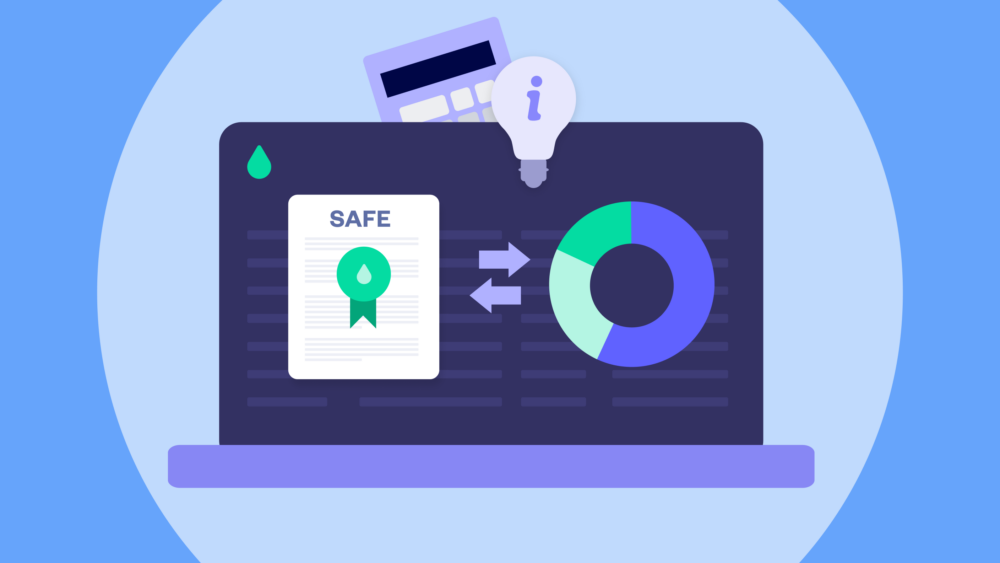
That’s why we’ve built a SAFE calculator to help you get a clear, realistic estimate of how your SAFEs are likely to convert.
And when it’s time to do the final, legally accurate conversion, the full SeedLegals platform runs the complete calculation for you automatically.
How do you calculate share conversions for a pre-money SAFE?
The math for pre-money SAFEs is fairly straightforward, because each investor converts independently. You don’t need to model the whole cap table in one go – you only need three things:
The valuation cap (if the SAFE has one)
The discount (if there is one)
The price per share (or “PPS”) from the new funding round
For each pre-money SAFE, you calculate two prices to give you the “conversion PPS”:
Cap price per share: the round valuation is replaced with the SAFE’s valuation cap. To get this, take the SAFE’s valuation cap and divide it by the company’s “capitalization” – that’s the total number of shares the company has already issued, plus the option pool and any other convertible instruments like SAFEs or notes – but not the new money coming in from the round.
Discounted price per share: the PPS in the round, reduced by the discount. So, if you’ve got a 20 percent discount on a $1.00 round, this gives a discounted PPS of $0.80.
Then the SAFE converts using whichever of those two prices is lower, because that gives the investor more shares for their money.
The formula is simple:
SAFE shares = Investment amount / Conversion PPS
Because pre-money SAFEs all convert before any of the new investment comes in – and without referencing each other – you’ll need to repeat the same process for every investor.
FAQs
What’s the conversion order if I have both pre-money and post-money SAFEs?
Pre-money SAFEs convert first – their conversions increase the total number of shares.
Afterwards, the post-money SAFEs convert using that updated share count. That total determines how many shares a post-money SAFE investor must receive to hit their fixed ownership percentage.
Do SAFE investors dilute each other?
Pre-money SAFEs do dilute other SAFE-holders. Every new pre-money SAFE increases the total number of shares, which dilutes all the earlier SAFEs because none of them have a fixed ownership percentage.
But post-money SAFEs don’t. Since post-money SAFEs give the investor a fixed percentage upfront, adding more SAFEs afterwards doesn’t dilute them – it dilutes the founders and existing shareholders instead.
Does the option pool dilute SAFE investors?
For pre-money SAFEs, it would. If you increase your option pool as part of the round, those extra shares sit in the cap table before the SAFEs convert, which means both founders and pre-money SAFE investors share the dilution.
But for post-money SAFEs, any new or increased option pool created as part of the priced round is typically excluded from the post-money SAFE conversion calculation. So that dilution usually falls on the founders and existing shareholders instead.
Can a SAFE convert without a priced round?
It depends on the wording of the SAFE agreement. The main trigger is a priced equity round, but most SAFEs also cover a liquidity event (like an acquisition or IPO). Also, if the company dissolves, the SAFE investor typically gets a cash repayment of their investment amount rather than shares.
What happens if multiple investors have identical cap and discount terms?
If their terms are identical, they convert on the same PPS.
That means neither influences the other’s outcome, and they receive shares proportionately based on their investment amounts.
Sort your SAFEs (and get ready for your next round)
If you’ve raised using SAFEs, SeedLegals helps you convert them cleanly when your priced round closes.
And if you’re planning to raise with SAFEs again, we’ll help you create, send and sign them in minutes.