Your first key hires make a real difference to your startup’s trajectory. But your salary budget at the early stages of your business probably won’t match bigger companies.
Stock options let startups close that gap. Your employees get the right to buy a piece of the company at today’s price, and if you build something valuable together down the line, that right becomes worth real money.
In this article, we’ll explain:
- What stock options are
- Why startups use them
- How grants and vesting work
- The difference between ISOs and NSOs
- How the strike price is set
- How big your option pool should be
- How to set up and run your plan
Plus we’ll cover the options mistakes that some first-time founders make.
What are stock options?
A stock option is the right to buy a set number of shares in your company at a fixed price (called a “strike price” or “exercise price”). The right usually lasts for a set period – typically 10 years – and it’s almost always earned gradually through a process called vesting.
Options are not the same as shares (or stock). A shareholder (or stockholder) is someone who owns part of your company right now. They can vote and appear on your cap table. An option holder owns a right to become a stockholder later. They don’t hold shares, they can’t vote and don’t show up on the cap table until they exercise their option – which means paying the strike price and buying the shares.
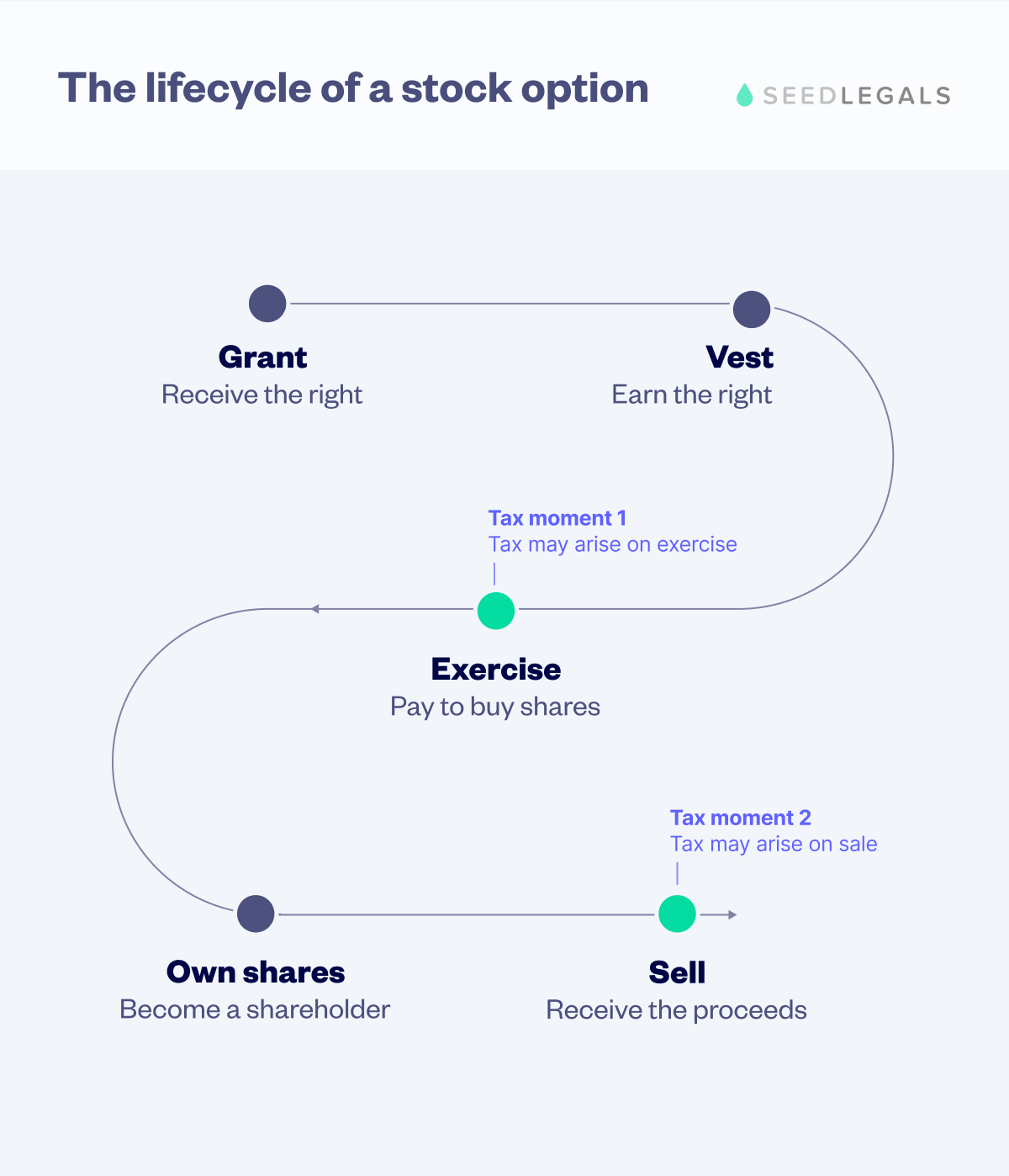
Every option follows the same lifecycle: Grant → vest → exercise → own shares → sell
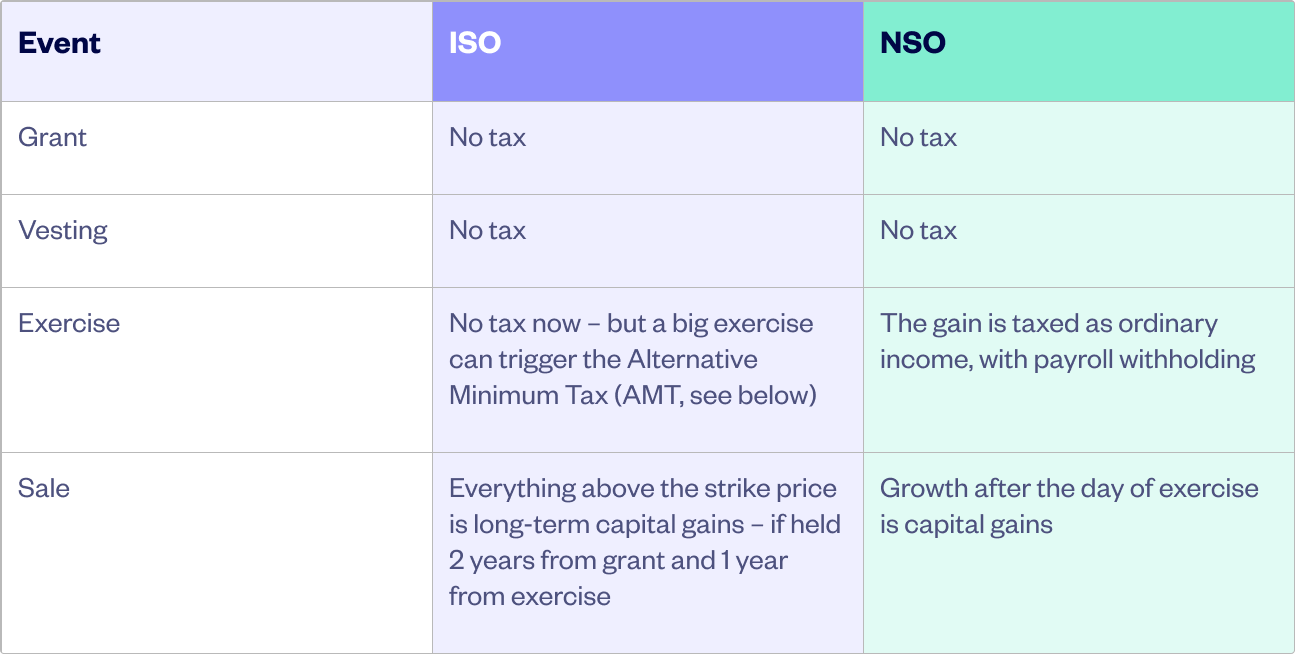
There are two moments in the lifecycle of an option where tax can arise – first, on exercise and second on a sale. We’ll go over these in more detail below.
You should also be aware of the key legal document behind options – called an equity incentive plan.
It’s also called a stock option plan, or employee stock option plan (“ESOP”). The option pool is the block of shares you reserve under that plan for future option grants.
📖 Read more: If you want to see how option holders (and the option pool) show up in your ownership numbers, read our cap table guide – what it is and why you need one
Why do startups use stock options?
There are three main reasons why stock options are commonly used by early-stage businesses.
🧲 To attract and keep talent you can’t yet afford. Options let you compete with bigger salaries by offering equity upside instead of cash. Industry data shows startups leaning on equity more and more, with grants to early hires rising fastest in AI and machine learning roles.
🎯 To align your team with the company. An option is worthless unless the company’s share price rises above the strike price. So an option holder’s incentive becomes the same as the business’s – to make the company as valuable as possible.
🤝 Because investors expect it. Most term sheets create or top up an option pool as part of the round. Offering equity is a standard part of building a startup in the US.
How do stock options work?
The easiest way to see the mechanics is to follow one grant from start to finish.
Stage 1 – The grant
Let’s meet Maya – the first engineer at your startup.
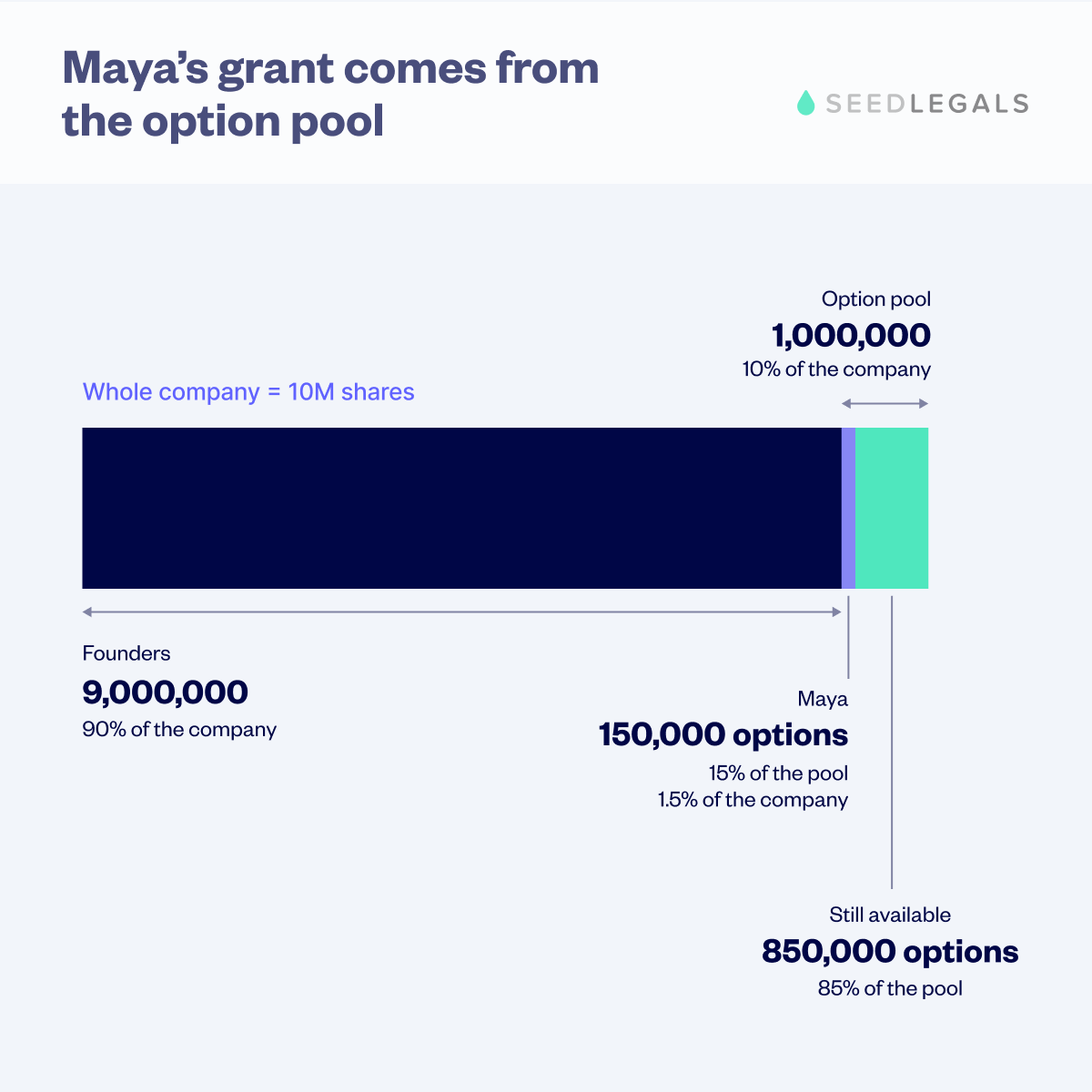
You and your co-founder hold 9,000,000 shares between you, and you’ve reserved a 1,000,000-share option pool (we’ll cover option pools in more depth below).
You’ve agreed to give Maya options over 150,000 shares – 1.5% of the company.
Options are granted under your equity incentive plan and approved by your board. The grant sets the number of shares, the option type, the strike price, the vesting schedule and the expiration date. A promise in an offer letter is not a grant. Until your board approves it, the recipient doesn’t really have anything.
For Maya, that means her equity becomes real at the board meeting where her grant is approved. The board approved her option over 150,000 shares (sometimes referred to as “150,000 options”) at a strike price of $1.00 (we’ll cover how that price is set later), vesting over four years, and expiring after 10.
Stage 2 – Vesting
Vesting is how option holders earn their options. In Maya’s case, it’s her gradually earning the right to buy shares at the old $1.00 price, no matter what they’re worth later.
Typically options vest over a time period – the longer someone stays, the more of their grant they get to keep. Vesting can also be linked to other milestones (like shipping a product, hitting a revenue target). But for startup employees, time-based vesting is almost always what’s used.
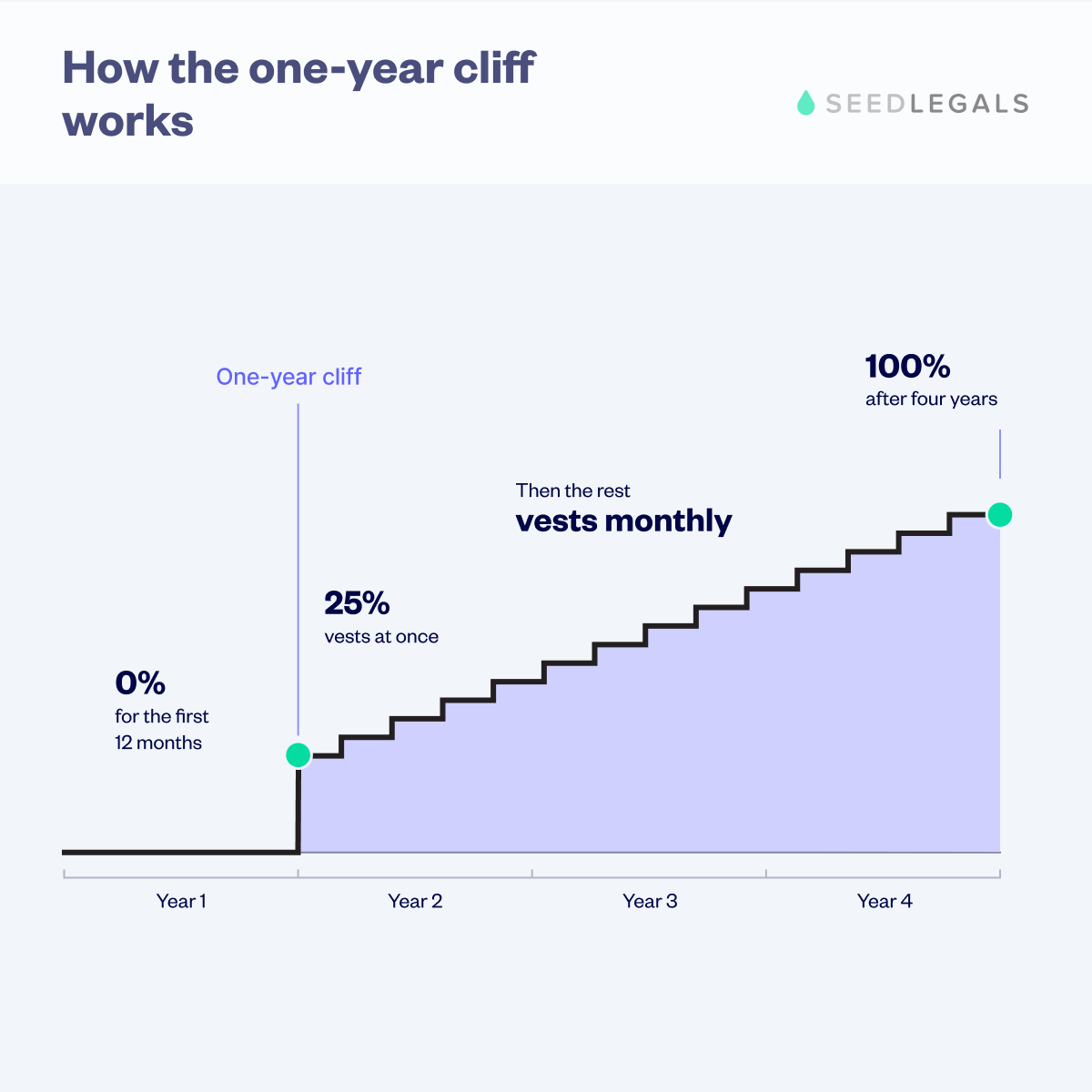
The standard vesting schedule is “four years with a one-year cliff”. That means nothing vests for the first 12 months, then 25% of the options vest at once. After that, the rest vest monthly.
So, on Maya’s schedule, nothing vests within her first year. Then, after exactly 12 months, 37,500 options (25%) vest. After that, 3,125 more vest each month until she’s fully vested at year four.
Stage 3 – Exercising
Once options have vested, the holder can “exercise” them – that means actually buying the shares.
The holder pays the strike price multiplied by the number of options to buy the stock and become a stockholder.
The company then issues the shares, and updates the cap table.
Maya doesn’t have to exercise the moment her options vest – most employees wait – but when she does, she pays $1.00 per vested share and becomes a stockholder.
🧠 Some plans let employees “early exercise” (meaning buy their shares before they’ve vested).
This can be a big tax win for the earliest hires, but it only works with an 83(b) election that’s filed within 30 days.
Here’s our guide on what an 83(b) election is and when you need one.
Stage 4 – When someone leaves
Generally, when an option holder leaves the company their unvested options go back into the option pool, and their vested options must be exercised within a specific window after termination – 90 days is standard.
If Maya left after 18 months, she’d have 56,250 vested options (out of 150,000) and 90 days to exercise them – the other 93,750 would go back into the company pool.
These are just the standard rules. In reality, all of this depends on what your plan documents say. They can be stricter – termination for cause, for example, can mean that person forfeits everything, vested or not, if the plan provides for it.
Should I grant ISOs or NSOs?
In the US, the law gives you two choices of options:
- Incentive stock options (ISOs), and
- Non-qualified stock options (NSOs).
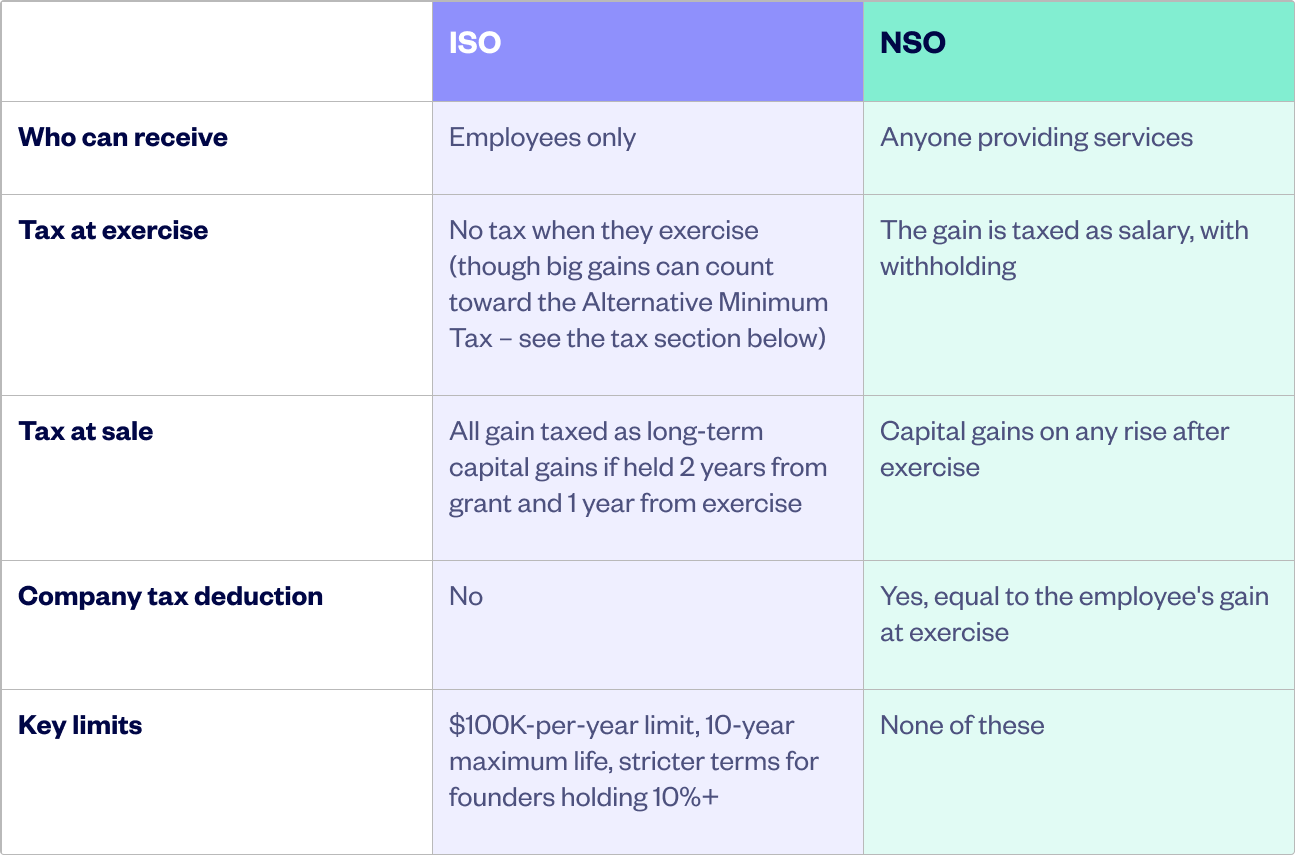
Generally, it’s a simple decision. ISOs are more tax efficient. So, if it’s a US employee, then grant ISOs.
If it’s a contractor, advisor, board member, or anyone not on payroll, then grant NSOs. ISOs aren’t allowed for them.
Here’s a simple table summarizing the differences between the two option types 👇
What is a strike price, and why do I need a 409A valuation?
The strike price is the fixed price an option holder pays per share when they exercise. The price is set on the day of the grant, no matter what the shares are worth by the time they buy.
That’s essentially the deal at the heart of every option – Maya pays $1.00 a share even if they’re worth $10 by then.
But you can’t set the strike price at any number – it must be at least the fair market value (FMV) of your common stock on the day of the grant. For a private company, that FMV comes from a 409A valuation – an independent appraisal. That’s where Maya’s $1.00 strike price needed to have come from.
Your 409A price is not your fundraising valuation. Investors buy preferred stock with special rights – but your team will typically get options over common stock, which is worth less (often a lot less early on). That gap is what makes options valuable to them.
A 409A stays valid for 12 months, or until something material changes (like a new priced round or an acquisition offer). So, get one before your first grant, then refresh it every 12 months or after every round.
If you skip this, it could have tax consequences for your employees. Options priced below FMV are taxed as they vest, plus a 20% additional federal tax, plus interest. Some states add their own penalty on top – for example, California’s is another 5%.
How much equity should I set aside?
The option pool
Most startups reserve 10-15% of their equity for employee options, with 10% being the most common starting point.
The best approach is to map out the people you expect to hire over the next 12–18 months, estimate how much equity each hire will need and size the pool according to that.
This matters when you raise funding. Investors will often ask you to create or enlarge the pool before they invest. Because the new shares are set aside before their money comes in, the resulting dilution falls on the existing shareholders rather than the new investor.
Investors therefore benefit from having a larger option pool in place before they invest. Suppose your hiring plan shows that five new hires will need options equal to 8% of the company, but an investor asks you to create a 15% pool before the funding round completes. The additional 7% would dilute the existing shareholders, but not the new investor. A detailed hiring plan gives you a concrete reason to argue that 8% is enough.
For each hire
Industry data on seed-stage startups puts the median grant for a first hire at about 1.5% of the company (that’s the same as Maya’s 150,000 options). This falls to around 0.85% for hire two, 0.5% for hire three and 0.33% by hire five.
Advisors typically get around 0.24% at pre-seed, sliding to 0.05% by Series A.
Dilution
Dilution is when your slice of the company shrinks because new shares (or rights to shares) are created – you own the same number of shares, but they make up a smaller percentage of a bigger pie.
Creating the pool is when you get your dilution. For example, an option pool of 1,000,000 shares next to your 9,000,000 took you and your co-founder’s ownership from 100% to 90% of the company on a fully diluted basis.
Actually granting from the pool doesn’t dilute anyone further – Maya’s options were already counted the day you created it.
📖 Read more : Startup equity: how much to give employees – role-by-role grant ranges – and our equity dilution calendar to model your own numbers.
How do I set up a stock option plan?
Here are the eight steps you need to take.
Step 1 – Check your share structure: Look at your certificate of incorporation and count what’s already issued. You need enough authorized but unissued common stock to cover the whole pool – if you don’t have it, amend the certificate before going further.
Step 2 – The board adopts the equity incentive plan: Your board signs off on the plan document itself. The plan must state the maximum number of shares that can ever be issued under it – that maximum is your option pool.
Step 3 – Stockholders approve the plan: Your stockholders (at the start, usually just the founders) approve the plan too. This must happen within 12 months of board adoption – without it, you can’t grant ISOs at all.
Step 4 – Get your 409A valuation: Commission the independent appraisal before anyone receives anything. It sets the fair market value of your common stock, which becomes the strike price for every grant you make while the valuation is current.
Step 5 – The board approves each grant: Every individual grant needs its own board approval, covering who receives it, how many shares, at what price, on what vesting schedule, and any special terms. If a term isn’t in the board approval, it doesn’t exist.
Step 6 – Sign the paperwork: The company and the option holder both sign a notice of grant and an option agreement. Then log the grant on your cap table, so your fully diluted numbers stay accurate.
Step 7 – Check securities law: Option grants are technically “offers of securities” – but almost every startup grant fits inside a ready-made exemption called Rule 701, so there’s no SEC registration to go with it. There are caps on how much you can grant in a year, and some states (like California) want a short notice filing – our Rule 701 guide walks through both.
Step 8 – Run the plan: Granting the option is the start of the process. You’ll need to track vesting and exercises, set aside room for “refresh” grants (top-up options for existing team members), refresh the 409A every 12 months or whenever something material changes, and file Form 3921 with the IRS each January (a short form that reports the previous year’s ISO exercises).
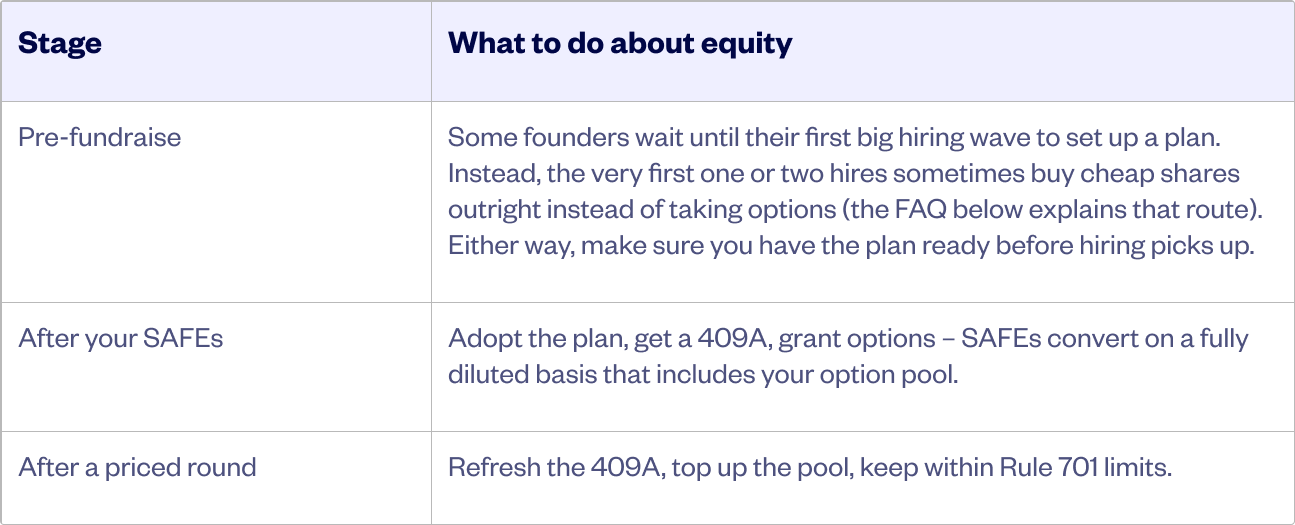
One thing to note on timing is that, once you’ve raised a priced round, you’ll usually need investor consent to make the pool bigger. It’s easier to set the pool up before you raise, so you can get the consent more easily.
Here’s how it typically plays out by stage:
How much does it cost to set up a stock option plan?
Done the traditional way, you’ll need a lawyer to set up your stock option plan for you – drafting the plan, consents and grant paperwork typically costs a few thousand dollars in legal fees – and that’s before your first grant. Then you need to pay for your 409A valuation (from around $1,000), plus more lawyer time every time you grant.
It’s why so many founders keep putting options off – and why employees often get promised-but-never-granted equity.
Raise faster with SeedLegals SAFEs
Create a SAFE that fits your startup's needs, with support from our team to help you nail down what you want.
Tell me more
How are stock options taxed?
This table gives you a summary of how options are taxed 👇
Let’s follow 10,000 of Maya’s vested options at her $1.00 strike price.
Years later the shares are worth $10 each. She exercises, which costs her $10,000, for shares that are worth $100,000 – so, it’s a $90,000 gain on paper.
- If they’re NSOs, that $90,000 is taxed straight away, as ordinary income through payroll – even though she hasn’t sold anything.
- If they’re ISOs, there’s no regular tax at exercise. But the $90,000 paper gain counts toward the Alternative Minimum Tax (AMT) – a parallel tax calculation that is triggered when someone exercises a lot of valuable options in one year. If it applies, Maya owes tax even though she hasn’t sold any stock (she can usually claim it back as a credit in later years). It’s a potential trap to warn employees about – our AMT guide explains when it applies.
- When she then sells at $25 after the ISO holding periods, her entire $240,000 gain is long-term capital gains – currently at a maximum of 20%, versus ordinary income rates of up to 37%. With NSOs, she’d pay capital gains only on the rise after exercise, having already been taxed on the first $90,000.
One more benefit is that shares bought by exercising options can qualify for Qualified Small Business Stock (QSBS) treatment – which can wipe out some or all of the federal capital gains tax after a few years. The clock starts at exercise, not when the options were granted.
This is general information, not tax advice – rates and thresholds change, so point your team to a tax advisor for their own situation.
What mistakes do first-time founders make?
- Promising equity in an offer letter and never granting it: An offer letter creates an expectation, not options. Until the board actually approves the grant, your hire owns nothing – and years of loose promises can surface as a mess in a due diligence process.
- Granting options before getting a 409A valuation (or on a stale one). If you price options below fair market value, the tax consequences land on your employees.
- Telling a hire they “own 1%”. They hold options, not shares, and the percentage changes with every round – talk in numbers of shares, with the percentage as today’s context.
- Granting in percentages instead of a fixed number of shares. “1% of the company” means a different number of shares after every raise – a grant should always be a specific count of shares.
- Granting ISOs to people who aren’t employees. Contractors, advisors and board members can only receive NSOs – an “ISO” granted to them simply won’t qualify as one (and will act like an NSO).
- Ignoring securities law. Rule 701 has limits and some states want notice filings. It’s some additional paperwork, yes – but avoids a painful clean-up later.
- Never explaining the grant. An option package will only motivate your team if they understand how it works.
- Not budgeting for refresh grants. If the pool is exhausted after your first hiring wave, topping it up mid-cycle needs board (and often investor) sign-off.
- Leaving the paperwork until a fundraise. Diligence will find every unapproved grant, missing signature and stale valuation – and you’ll be fixing them under the pressure of completing a deal.
- Missing the filings. Form 3921 goes to the IRS every January for ISO exercises, and 83(b) elections have a strict 30-day deadline after early exercise.
Set up your stock options on SeedLegals
Stock options shouldn’t be complicated.
SeedLegals gives you the documents, workflows and expert support to set up your stock option plan, make your first grants the right way, and keep your cap table accurate as you grow.
Book a call below or start your 7-day free trial today.
Get answers fast, for free
Bring all your questions - we’ve got the answers!
We’ll match you with the right specialist.
FAQs
-
Yes. It sets a defensible strike price and protects your employees from serious tax penalties. It stays valid for 12 months unless something material changes.
-
10-15% is typical, with 10% the most common. Size it to your next 12-18 months of hiring, not to what a term sheet suggests.
-
Yes – as NSOs (ISOs are employees-only). Non-US hires can receive options, but local tax rules apply, so get local advice according to where they’re based.
-
Typically, unvested options return to the pool. Vested options must be exercised within the post-termination window – typically 90 days – or they expire. That’s the standard arrangement – your company’s plan documents can vary that.
-
No – stock options need a corporation. LLCs use profits interests instead, one of the reasons startups convert to a Delaware C corp before granting equity – SeedLegals can help you do that.
-
Only $100,000 of options (measured by value at grant) can first become exercisable per employee per calendar year with ISO treatment. Anything above that automatically becomes an NSO – so make sure you track it. We cover this in more detail in our ISO vs NSO guide.
-
In an acquisition, vested options are typically cashed out or converted into acquirer equity. What happens to unvested options depends on the deal and any acceleration terms in your plan or the grant agreement. In an IPO, holders can exercise and sell once the lock-up period ends. A lock-up period is a set window after a company goes public (usually around six months) during which insiders aren’t allowed to sell.
-
Sometimes, yes – but only in a narrow window.
Before you raise, shares can cost so little that it can be simpler for your first one or two hires to buy them outright rather than wait for options. The shares can still be subject to vesting, just like options – and if someone leaves early, the company can buy back the unvested ones. Lawyers call these cheap early shares “restricted stock”.
Owning shares early usually means less tax later (you’ll need to file an 83(b) election within 30 days).
Plenty of startups grant options before raising too. But once your shares have real value (usually after your first round), buying them outright stops being realistic, and options become the practical route for every hire.
-
An RSU is a promise of free shares later, rather than a right to buy them at a set price. They only make sense once your shares are worth so much that options stop being attractive – usually years after Series A.
So for early hires, the real choice is the one in the previous question – cheap shares or options. RSUs come much later.